and old universes depleted of energy and matter
and antimatter
does that matter to doctor who?
who knows....
joi, 31 martie 2016

WHEN THE SOMATORY OF ALL COEFFICIENTS OF CONTRACTION TENDS TO INFINITY YOU HAVE A PONTUAL UNIVERSE -the expansion of the universe started to accelerate recently (meaning a few billion ...BUT IS ONLY A PONTUAL MEMENTO MORI OF ALL UNIVERSES THE SOMATORY OF ALL EXPANSION IS BIGGER THAN ALL THEPONTUAL CONTRACTIONS IN THE FORM OF BLACK HOLES AND OTHER ASS HOLES DA GAMMA RAY ..... Homogeneity requires the proportionality coefficient to be only a function of time.
Expansion of the Universe
One of the main goals of cosmology is to figure out how the universe expands as a function of time.
1.1 Expansion and Conservation
To describe the evolution of the average universe, one needs only two kinds of equations:
1. The equation that relates the density and pressure of constituents of the universe (such as
baryons, cold dark matter, photons, neutrinos, dark energy) to the expansion of the universe,
and
2. The equation that describes the energy conservation of the constituents.
Consider a line connecting two arbitrary points in space (which is expanding), and call it L. As the
universe expands, L changes with time. As you will derive in homework using
General Relativity, the equation of motion for L is given by
L¨(t) = − 4πG 3 L(t) X i [ρi(t) + 3Pi(t)] ,
(1.1) where ρi(t) and Pi(t) are the energy and pressure of the ith component of the universe, respectively. Here, note that the absolute value of L does not affect the equation of motion for L. Therefore, one may define a dimensionless “scale factor,” a(t), such that L(t) ≡ a(t)x, where x is a timeindependent separation called a “comoving” separation, which is in units of length. In cosmology, 1 we often encounter the Hubble expansion rate, H(t), which is defined by H(t) ≡ a˙(t) a(t) . (1.2) The dimension of this quantity is 1/(time). The age of the universe can be calculated from the above definition of H, which gives H(t)dt = da/a. Now, if we know H as a function of a instead of t, we obtain t = Z da aH(a) . (1.3) Another interpretation of H is found by writing L˙(t) = H(t)L(t), which tells us that H(t) gives a relation between the distance, L, and the recession velocity, L˙ . For this reason, it is often convenient to write H(t) in the following peculiar units: H(t) = 100 h(t) km/s/Mpc, where h is a dimensionless quantity. The current observations suggest that the present-day value of h is h(ttoday) ≈ 0.7.∗ Dividing both sides of equation (1.1) by L and using L(t) = a(t)x, we find one of the key equations connecting the energy density and pressure to the expansion of the universe: a¨(t) a(t) = − 4πG 3 X i [ρi(t) + 3Pi(t)] (1.4) As expected, positive energy density and positive pressure slow down the expansion of the universe.† This equation cannot be solved unless we know how ρi and Pi depend on time. How ρi depends on time is given by the energy conservation equation, while how Pi depends on time is usually given by the equation of state relating Pi to ρi and other quantities. As you will derive in homework, the energy conservation equation is given by X i ρ˙i(t) + 3a˙(t) a(t) X i [ρi(t) + Pi(t)] = 0 (1.5) Equation (1.5) is general and does not assume presence or absence of possible interactions between different components. If we assume that each component is conserved separately, then we have ρ˙i(t) + 3a˙(t) a(t) [ρi(t) + Pi(t)] = 0, (1.6) ∗The most precise value of h(ttoday) to date from the direct measurement using low-z supernovae and Cepheid variable stars is h(ttoday) = 0.742 ± 0.036 (Riess, Macri, et al., ApJ, 699, 539 (2009)). † If we ignore the effect of pressure relative to that of the energy density (which is always a good approximation for non-relativistic matter), and write ρ(t) in terms of the total mass enclosed with a radius L, P i ρi(t) = 3M 4πL3 , then equation (1.1) becomes L¨ = − GM L2 , which is the familiar Newtonian inverse-square law. Although one must not apply the Newtonian mechanics to describe the evolution of space (because Newtonian mechanism assumes static space), this is a convenient way to understand equations (1.1) and (1.4)for each of the ith component. Note that the second term contains the pressure, and thus how the energy density evolves depends on the pressure.‡ Looking at equations (1.4) and (1.5), one might think that we cannot solve for a(t) unless we have the equation of state giving Pi(t) as a function of ρi(t) etc. While in general that would be true, for these equations a little mathematical trick lets us combine equations (1.4) and (1.5) without knowing the evolution of P(t)! First, rewrite equation (1.4) as a¨(t) a(t) = 8πG 3 X i ρi(t) − 4πGX i [ρi(t) + Pi(t)] . (1.7) Using equation (1.5) on the second term of the right hand side, we get a¨(t) a(t) = 8πG 3 X i ρi(t) + 4πG 3 a(t) a˙(t) X i ρ˙i(t) a˙(t)¨a(t) = 8πGa(t)˙a(t) 3 X i ρi(t) + 4πGa2 (t) 3 X i ρ˙i(t) 1 2 (˙a 2 ) · = 4πG(a 2 ) · 3 X i ρi(t) + 4πGa2 (t) 3 X i ρ˙i(t). (1.8) As this has the form of A˙ = BC˙ + BC˙ = (BC) · , it is easy to integrate and obtain: a˙ 2 (t) = 8πGa2 (t) 3 X i ρi(t) − κ, (1.9) where κ is an integration constant, which is in units of 1/(time)2 . (A negative sign is for a historical reason.) Dividing both sides by a 2 (t), we finally arrive at the so-called Friedmann equation: a˙ 2 (t) a 2(t) = 8πG 3 X i ρi(t) − κ a 2(t) . (1.10) ‡While it is a wrong explanation, it is useful to compare this equation to the first law of thermodynamics: T dS = dU + P dV, where T, S, U, and V are the temperature, entropy, internal energy, and volume, respectively. To a very good accuracy, the entropy is conserved in the universe, dS = 0. The internal energy is U ∝ ρa3 and the volume is V ∝ a 3 , and thus d(ρa 3 ) + P d(a 3 ) = 0, which gives ρ˙ + 3a˙ a (ρ + P) = 0. This is a wrong explanation because it assumes that the pressure is doing work as a increases. However, in the average universe, the pressure is the same everywhere, and thus there is no under-pressure region against which the pressure can do work. Equation (1.5) must be derived using GR, which you will do in homework, but the above thermodynamic argument is an amusing way to arrive at the same equation. Also, this gives us some confidence that it is not crazy to think that the evolution of ρ depends on P. 3 A beauty of this equation is that it is easy to solve, once a time dependence of ρi(t) is known, which is usually the case. General Relativity tells us that the integration constant, κ, is equal to ±c 2/R2 where R is the curvature radius of the universe (in units of length) and c the speed of light. When the geometry of the universe is flat (as suggested by observations), R → ∞ (giving κ → 0), and thus one can ignore this term. Since we have so much to learn, to save time we will not consider the curvature of the universe throughout (most of) this lecture: a˙ 2 (t) a 2(t) = 8πG 3 X i ρi(t) (1.11) 1.2 Solutions of Friedmann Equation In order to use solve equation (1.11) for a(t), one must know how ρi(t) depends on time. To find solutions for a(t), let us first assume that the universe is dominated by one energy component at a time, i.e., a˙ 2 (t) a 2(t) = 8πG 3 X i ρi(t) ≈ 8πG 3 ρi(t), (1.12) and further assume that ρi depends on a(t) via a power-law: ρi(t) ∝ 1 a ni (t) . (1.13) 4 Finding the solution is straightforward: a(t) ∝ t 2/ni . (1.14) This is usually an excellent approximation, except for the transition era where two energy components are equally important. There are 3 important cases: 1. Radiation-dominated (RD) era. A radiation component (photons, massless neutrinos, or any other massless particles) has a large pressure, PR = ρR/3,§ which gives ρR(t) ∝ 1/a4 (t), or nR = 4. We thus obtain aRD(t) ∝ t 1/2 . (1.15) The expansion of the universe decelerates. With this solution, we can relate the age of the universe to the Hubble expansion rate: H(t) = a˙(t) a(t) = 1 2t . (1.16) 2. Matter-dominated (MD) era. A matter component (baryons, cold dark matter, or any other non-relativistic particles) has a negligible pressure compared to its energy density, PM ρM, which gives ρM(t) ∝ 1/a3 (t), or nM = 3. We thus obtain aMD(t) ∝ t 2/3 . (1.17) §Again, a “wrong” derivation, but there is an intuitive way to get this result using the equation of state for non-relativistic ideal gas (this is obviously a wrong derivation because we are about to apply non-relativistic equation of state to relativistic gas!): P = nkBT = ρ kBT hEi , where n is the number density, T the temperature of gas, kB the Boltzmann constant, and hEi the mean energy per particle. For relativistic particles in thermal equilibrium, hEi ≈ 3kBT, which gives P ≈ ρ/3. Now, actually, it turns out that the error we are making by using non-relativistic equation of state for relativistic gas cancels out precisely the error we are making by using an approximate relation hEi ≈ 3kBT. This gives us the exact relation, P = ρ/3 for relativistic particles. More precisely, the equation of state for relativistic gas takes on the form P = (1 + )ρ kBT hEi with hEi = 3(1 + )kBT, giving P = ρ/3. Here, ' 0.05 and −0.10 for Fermions and Bosons, respectively. 5 The expansion of the universe decelerates. With this solution, we can relate the age of the universe to the Hubble expansion rate: H(t) = a˙(t) a(t) = 2 3t . (1.18) 3. Constant-energy-density-dominated (ΛD) era. A hypothetical energy component (let’s call it Λ) whose energy density is a constant over time, nΛ = 0. In this case we cannot use equation (1.14). Going back to equation (1.12) and setting ρΛ = constant, we get ˙a/a = constant, whose solution is aΛD(t) ∝ e Ht , (1.19) where an integration constant, H, is the same as the Hubble expansion rate (which is a constant for this model). The expansion of the universe accelerates, which must mean that, according to the acceleration equation (1.4), the pressure of this energy component is negative. The conservation equation (1.5) tells us that such a component indeed has an enormous negative pressure given by PΛ = −ρΛ. (1.20) While this looks quite strange, we now know that something like this may actually exist in our universe, as the current observations suggest that the present-day universe is indeed accelerating. 6 1.3 Equation of State of “Dark Energy” and Density Parameters The matter has PM ρM; the radiation has PR = ρR/3; and Λ has PΛ = −ρΛ. This motivates our writing the equation of state of the ith component in the following simple form: Pi = wiρi . (1.21) Here, wi is called the “equation of state parameter,” and can depend on time (although it is usually taken to be constant). Why this form? It is important to keep in mind that there is no fundamental reason why we should use this form. This form is often used either just for convenience, or simply for parametrizing something we do not know. At the very least, this form is exact for radiation, wR = 1/3, and for Λ, wΛ = −1. For matter, since wM 1, the exact value does not affect the results very much. The equation of state parameter is almost exclusively used for parametrizing “dark energy,” which is supposed to cause the observed acceleration of the universe. If we assume that w for dark energy, wDE, is constant, then the current observations suggest that (Komatsu, et al., ApJS, 192, 18 (2011)) wDE = −0.98 ± 0.05 (68% CL). (1.22) In other words, the energy density of dark energy is consistent with being a constant (wDE = wΛ = −1). Determining wDE with better accuracy may tell us something about the nature of dark energy, especially if wDE 6= 1 is found with high statistical significance, as it would tell us that dark energy is something dynamical (time-dependent). Ignoring a potential interaction between dark energy and other components in the universe (e.g., dark matter), the energy density of dark energy obeys (see equation (1.6)) ρ˙DE(t) + 3a˙(t) a(t) (1 + wDE) ρDE(t) = 0, (1.23) whose solution is ρDE(t) ∝ [a(t)]−3(1+wDE) . On the other hand, if we do not assume that wDE is a constant, then the energy density of dark energy obeys ρ˙DE(t) + 3a˙(t) a(t) [1 + wDE(t)] ρDE(t) = 0, (1.24) whose solution is ρDE(t) ∝ e −3 R d ln a[1+wDE(a)] . (1.25) Putting these results together, we obtain the Friedmann equation for our Universe containing radiation, matter, and dark energy (but not curvature) as a˙ 2 (t) a 2(t) = H2 (t) = 8πG 3 ρM(t0) a 3 (t0) a 3(t) + ρR(t0) a 4 (t0) a 4(t) + ρDE(t0)e −3 R a(t) a(t0) d ln a[1+wDE(a)] , (1.26) where t0 is some epoch, which is usually taken to be the present epoch.
Equation of State of “Dark Energy” and Density Parameters The matter has PM ρM; the radiation has PR = ρR/3; and Λ has PΛ = −ρΛ. This motivates our writing the equation of state of the ith component in the following simple form: Pi = wiρi . (1.21) Here, wi is called the “equation of state parameter,” and can depend on time (although it is usually taken to be constant). Why this form? It is important to keep in mind that there is no fundamental reason why we should use this form. This form is often used either just for convenience, or simply for parametrizing something we do not know. At the very least, this form is exact for radiation, wR = 1/3, and for Λ, wΛ = −1. For matter, since wM 1, the exact value does not affect the results very much. The equation of state parameter is almost exclusively used for parametrizing “dark energy,” which is supposed to cause the observed acceleration of the universe. If we assume that w for dark energy, wDE, is constant, then the current observations suggest that (Komatsu, et al., ApJS, 192, 18 (2011)) wDE = −0.98 ± 0.05 (68% CL). (1.22) In other words, the energy density of dark energy is consistent with being a constant (wDE = wΛ = −1). Determining wDE with better accuracy may tell us something about the nature of dark energy, especially if wDE 6= 1 is found with high statistical significance, as it would tell us that dark energy is something dynamical (time-dependent). Ignoring a potential interaction between dark energy and other components in the universe (e.g., dark matter), the energy density of dark energy obeys (see equation (1.6)) ρ˙DE(t) + 3a˙(t) a(t) (1 + wDE) ρDE(t) = 0, (1.23) whose solution is ρDE(t) ∝ [a(t)]−3(1+wDE) . On the other hand, if we do not assume that wDE is a constant, then the energy density of dark energy obeys ρ˙DE(t) + 3a˙(t) a(t) [1 + wDE(t)] ρDE(t) = 0, (1.24) whose solution is ρDE(t) ∝ e −3 R d ln a[1+wDE(a)] . (1.25) Putting these results together, we obtain the Friedmann equation for our Universe containing radiation, matter, and dark energy (but not curvature) as a˙ 2 (t) a 2(t) = H2 (t) = 8πG 3 ρM(t0) a 3 (t0) a 3(t) + ρR(t0) a 4 (t0) a 4(t) + ρDE(t0)e −3 R a(t) a(t0) d ln a[1+wDE(a)] , (1.26) where t0 is some epoch, which is usually taken to be the present epoch. 7 Now, taking t → t0, we find the present-day expansion rate H2 0 ≡ H2 (t0) = 8πG 3 [ρM(t0) + ρR(t0) + ρDE(t0)] ≡ 8πG 3 ρc(t0), (1.27) which has been determined to be H0 ≈ 70 km/s/Mpc. Here, ρc(t0) is the so-called “critical density” of the universe, which is equal to the total energy density of the universe when the universe is flat. The numerical value of the critical density is ρc(t0) ≡ 3H2 0 8πG = 2.775 × 10¹¹ h 2 M Mpc−3 . (1.28) The critical density provides a natural unit for the energy density of the universe, and thus it is convenient to measure all the energy densities in units of ρc(t0). Defining the so-called density parameters, Ωi , as Ωi ≡ ρi(t0) ρc(t0) , (1.29) one can rewrite the Friedmann equation (1.26) in a compact form: H2 (t) H2 0 = ΩM a 3 (t0) a 3(t) + ΩR a 4 (t0) a 4(t) + ΩDEe −3 R a(t) a(t0) d ln a[1+wDE(a)] (1.30) Basically, most of the literature on cosmology (within the context of General Relativity) use this equation as the starting point.¶ Taking z = 0, one finds that all the density parameters must sum to unity: P i Ωi = 1. In summary, the Friedmann equation is a combination of two key equations: (1) the equation describing how the universe decelerates/accelerates depending on the energy density and pressure of the constituents, and (2) the equation describing the energy conservation of the constituents. Once the Friedmann equation is given with the proper right hand side containing the energy densities of the relevant constituents of the universe, we can find a(t) as a function of time easily. ¶An interesting possibility is that General Relativity may not be valid on cosmological scales. There are scenarios in which the form of the Friedmann equation is modified. One widely-explored example is the so-called DvaliGabadadze-Porrati (DGP) model (Dvali, Gabadadze & Porrati, Phys. Lett. B485, 208 (2000)). In this scenario, the Friedmann equation is modified to: H 2 (t) − H(t) rc = 8πG 3 X i ρi(t), where rc is some length scale below which General Relativity is restored. (For r rc, the potential is given by −GN m/r where GN is the ordinary Newtonian gravitational constant. For r rc, the potential is modified to −G5m/r2 and decays faster. G5 is the gravitational strength in the 5th dimension.) This model has attracted a huge attention of the cosmology community, as it was shown that this modified Friedmann equation gives an accelerating expansion without dark energy. Namely, even when the right hand side contains only matter, the solution for this equation can still exhibit an accelerating expansion. As this is a quadratic equation for H(t), we can solve it and find H(t) = 1 2 1 rc ± r 1 r 2 c + 32πG 3 ρM(t) . At late times when ρ(t) becomes negligible compared to the other term, one of the solutions is given by a(t) ∝ e t/rc , i.e., an exponential, accelerated expansion. 8 At present, the radiation is totally negligible compared to matter, ΩR/ΩM ' 1/3250, and the dark energy density is about 3 times as large as the matter density, ΩDE/ΩM ' 2.7 (with ΩM ' 0.27 and ΩDE ' 0.73). 1.4 Redshift As the universe expands, the wavelength of light, λ, is stretched linearly: λ(t) ∝ a(t), (1.31) which implies that photons lose energy as E(t) ∝ 1/a(t). This is something one can observe, by comparing, for example, the observed wavelength of a hydrogen line to the rest-frame wavelength that we know from the laboratory experiment. We often use the redshift, z, to quantify the stretching of the wavelength: 1 + z ≡ λ(t0) λ(temitted) . (1.32) The present-day corresponds to z = 0. Using equation (1.31), we can relate the observed redshift to the ratio of the scale factors: 1 + z = a(t0) a(temitted) . (1.33) Using this result in the Friedmann equation (1.30), we obtain the most-widely-used form of the Friedmann equation:
H2 (z) H2 0 = ΩM(1 + z) 3 + ΩR(1 + z) 4 + ΩDEe 3 R z 0 d ln(1+z)[1+wDE(z)From this result, it follows that the best way to determine the equation of state of dark energy is to measure H(z) over a wide range of z. If we can only measure the expansion rates at z 1, then Taylor expansion of equation (1.34) with ΩR ΩM and ΩDE ' 1 − ΩM gives H2 (z 1) H2 0 ≈ 1 + 3ΩMz + 3(1 + wDE)(1 − ΩM)z. (1.35) As we know from observations that |1 + wDE| is small (of order 10−1 or less), the third term is tiny compared to other terms, making it difficult to measure wDE. This is why we need to measure H(z) over a wide redshift range
General Relativity, the equation of motion for L is given by
L¨(t) = − 4πG 3 L(t) X i [ρi(t) + 3Pi(t)] ,
(1.1) where ρi(t) and Pi(t) are the energy and pressure of the ith component of the universe, respectively. Here, note that the absolute value of L does not affect the equation of motion for L. Therefore, one may define a dimensionless “scale factor,” a(t), such that L(t) ≡ a(t)x, where x is a timeindependent separation called a “comoving” separation, which is in units of length. In cosmology, 1 we often encounter the Hubble expansion rate, H(t), which is defined by H(t) ≡ a˙(t) a(t) . (1.2) The dimension of this quantity is 1/(time). The age of the universe can be calculated from the above definition of H, which gives H(t)dt = da/a. Now, if we know H as a function of a instead of t, we obtain t = Z da aH(a) . (1.3) Another interpretation of H is found by writing L˙(t) = H(t)L(t), which tells us that H(t) gives a relation between the distance, L, and the recession velocity, L˙ . For this reason, it is often convenient to write H(t) in the following peculiar units: H(t) = 100 h(t) km/s/Mpc, where h is a dimensionless quantity. The current observations suggest that the present-day value of h is h(ttoday) ≈ 0.7.∗ Dividing both sides of equation (1.1) by L and using L(t) = a(t)x, we find one of the key equations connecting the energy density and pressure to the expansion of the universe: a¨(t) a(t) = − 4πG 3 X i [ρi(t) + 3Pi(t)] (1.4) As expected, positive energy density and positive pressure slow down the expansion of the universe.† This equation cannot be solved unless we know how ρi and Pi depend on time. How ρi depends on time is given by the energy conservation equation, while how Pi depends on time is usually given by the equation of state relating Pi to ρi and other quantities. As you will derive in homework, the energy conservation equation is given by X i ρ˙i(t) + 3a˙(t) a(t) X i [ρi(t) + Pi(t)] = 0 (1.5) Equation (1.5) is general and does not assume presence or absence of possible interactions between different components. If we assume that each component is conserved separately, then we have ρ˙i(t) + 3a˙(t) a(t) [ρi(t) + Pi(t)] = 0, (1.6) ∗The most precise value of h(ttoday) to date from the direct measurement using low-z supernovae and Cepheid variable stars is h(ttoday) = 0.742 ± 0.036 (Riess, Macri, et al., ApJ, 699, 539 (2009)). † If we ignore the effect of pressure relative to that of the energy density (which is always a good approximation for non-relativistic matter), and write ρ(t) in terms of the total mass enclosed with a radius L, P i ρi(t) = 3M 4πL3 , then equation (1.1) becomes L¨ = − GM L2 , which is the familiar Newtonian inverse-square law. Although one must not apply the Newtonian mechanics to describe the evolution of space (because Newtonian mechanism assumes static space), this is a convenient way to understand equations (1.1) and (1.4)for each of the ith component. Note that the second term contains the pressure, and thus how the energy density evolves depends on the pressure.‡ Looking at equations (1.4) and (1.5), one might think that we cannot solve for a(t) unless we have the equation of state giving Pi(t) as a function of ρi(t) etc. While in general that would be true, for these equations a little mathematical trick lets us combine equations (1.4) and (1.5) without knowing the evolution of P(t)! First, rewrite equation (1.4) as a¨(t) a(t) = 8πG 3 X i ρi(t) − 4πGX i [ρi(t) + Pi(t)] . (1.7) Using equation (1.5) on the second term of the right hand side, we get a¨(t) a(t) = 8πG 3 X i ρi(t) + 4πG 3 a(t) a˙(t) X i ρ˙i(t) a˙(t)¨a(t) = 8πGa(t)˙a(t) 3 X i ρi(t) + 4πGa2 (t) 3 X i ρ˙i(t) 1 2 (˙a 2 ) · = 4πG(a 2 ) · 3 X i ρi(t) + 4πGa2 (t) 3 X i ρ˙i(t). (1.8) As this has the form of A˙ = BC˙ + BC˙ = (BC) · , it is easy to integrate and obtain: a˙ 2 (t) = 8πGa2 (t) 3 X i ρi(t) − κ, (1.9) where κ is an integration constant, which is in units of 1/(time)2 . (A negative sign is for a historical reason.) Dividing both sides by a 2 (t), we finally arrive at the so-called Friedmann equation: a˙ 2 (t) a 2(t) = 8πG 3 X i ρi(t) − κ a 2(t) . (1.10) ‡While it is a wrong explanation, it is useful to compare this equation to the first law of thermodynamics: T dS = dU + P dV, where T, S, U, and V are the temperature, entropy, internal energy, and volume, respectively. To a very good accuracy, the entropy is conserved in the universe, dS = 0. The internal energy is U ∝ ρa3 and the volume is V ∝ a 3 , and thus d(ρa 3 ) + P d(a 3 ) = 0, which gives ρ˙ + 3a˙ a (ρ + P) = 0. This is a wrong explanation because it assumes that the pressure is doing work as a increases. However, in the average universe, the pressure is the same everywhere, and thus there is no under-pressure region against which the pressure can do work. Equation (1.5) must be derived using GR, which you will do in homework, but the above thermodynamic argument is an amusing way to arrive at the same equation. Also, this gives us some confidence that it is not crazy to think that the evolution of ρ depends on P. 3 A beauty of this equation is that it is easy to solve, once a time dependence of ρi(t) is known, which is usually the case. General Relativity tells us that the integration constant, κ, is equal to ±c 2/R2 where R is the curvature radius of the universe (in units of length) and c the speed of light. When the geometry of the universe is flat (as suggested by observations), R → ∞ (giving κ → 0), and thus one can ignore this term. Since we have so much to learn, to save time we will not consider the curvature of the universe throughout (most of) this lecture: a˙ 2 (t) a 2(t) = 8πG 3 X i ρi(t) (1.11) 1.2 Solutions of Friedmann Equation In order to use solve equation (1.11) for a(t), one must know how ρi(t) depends on time. To find solutions for a(t), let us first assume that the universe is dominated by one energy component at a time, i.e., a˙ 2 (t) a 2(t) = 8πG 3 X i ρi(t) ≈ 8πG 3 ρi(t), (1.12) and further assume that ρi depends on a(t) via a power-law: ρi(t) ∝ 1 a ni (t) . (1.13) 4 Finding the solution is straightforward: a(t) ∝ t 2/ni . (1.14) This is usually an excellent approximation, except for the transition era where two energy components are equally important. There are 3 important cases: 1. Radiation-dominated (RD) era. A radiation component (photons, massless neutrinos, or any other massless particles) has a large pressure, PR = ρR/3,§ which gives ρR(t) ∝ 1/a4 (t), or nR = 4. We thus obtain aRD(t) ∝ t 1/2 . (1.15) The expansion of the universe decelerates. With this solution, we can relate the age of the universe to the Hubble expansion rate: H(t) = a˙(t) a(t) = 1 2t . (1.16) 2. Matter-dominated (MD) era. A matter component (baryons, cold dark matter, or any other non-relativistic particles) has a negligible pressure compared to its energy density, PM ρM, which gives ρM(t) ∝ 1/a3 (t), or nM = 3. We thus obtain aMD(t) ∝ t 2/3 . (1.17) §Again, a “wrong” derivation, but there is an intuitive way to get this result using the equation of state for non-relativistic ideal gas (this is obviously a wrong derivation because we are about to apply non-relativistic equation of state to relativistic gas!): P = nkBT = ρ kBT hEi , where n is the number density, T the temperature of gas, kB the Boltzmann constant, and hEi the mean energy per particle. For relativistic particles in thermal equilibrium, hEi ≈ 3kBT, which gives P ≈ ρ/3. Now, actually, it turns out that the error we are making by using non-relativistic equation of state for relativistic gas cancels out precisely the error we are making by using an approximate relation hEi ≈ 3kBT. This gives us the exact relation, P = ρ/3 for relativistic particles. More precisely, the equation of state for relativistic gas takes on the form P = (1 + )ρ kBT hEi with hEi = 3(1 + )kBT, giving P = ρ/3. Here, ' 0.05 and −0.10 for Fermions and Bosons, respectively. 5 The expansion of the universe decelerates. With this solution, we can relate the age of the universe to the Hubble expansion rate: H(t) = a˙(t) a(t) = 2 3t . (1.18) 3. Constant-energy-density-dominated (ΛD) era. A hypothetical energy component (let’s call it Λ) whose energy density is a constant over time, nΛ = 0. In this case we cannot use equation (1.14). Going back to equation (1.12) and setting ρΛ = constant, we get ˙a/a = constant, whose solution is aΛD(t) ∝ e Ht , (1.19) where an integration constant, H, is the same as the Hubble expansion rate (which is a constant for this model). The expansion of the universe accelerates, which must mean that, according to the acceleration equation (1.4), the pressure of this energy component is negative. The conservation equation (1.5) tells us that such a component indeed has an enormous negative pressure given by PΛ = −ρΛ. (1.20) While this looks quite strange, we now know that something like this may actually exist in our universe, as the current observations suggest that the present-day universe is indeed accelerating. 6 1.3 Equation of State of “Dark Energy” and Density Parameters The matter has PM ρM; the radiation has PR = ρR/3; and Λ has PΛ = −ρΛ. This motivates our writing the equation of state of the ith component in the following simple form: Pi = wiρi . (1.21) Here, wi is called the “equation of state parameter,” and can depend on time (although it is usually taken to be constant). Why this form? It is important to keep in mind that there is no fundamental reason why we should use this form. This form is often used either just for convenience, or simply for parametrizing something we do not know. At the very least, this form is exact for radiation, wR = 1/3, and for Λ, wΛ = −1. For matter, since wM 1, the exact value does not affect the results very much. The equation of state parameter is almost exclusively used for parametrizing “dark energy,” which is supposed to cause the observed acceleration of the universe. If we assume that w for dark energy, wDE, is constant, then the current observations suggest that (Komatsu, et al., ApJS, 192, 18 (2011)) wDE = −0.98 ± 0.05 (68% CL). (1.22) In other words, the energy density of dark energy is consistent with being a constant (wDE = wΛ = −1). Determining wDE with better accuracy may tell us something about the nature of dark energy, especially if wDE 6= 1 is found with high statistical significance, as it would tell us that dark energy is something dynamical (time-dependent). Ignoring a potential interaction between dark energy and other components in the universe (e.g., dark matter), the energy density of dark energy obeys (see equation (1.6)) ρ˙DE(t) + 3a˙(t) a(t) (1 + wDE) ρDE(t) = 0, (1.23) whose solution is ρDE(t) ∝ [a(t)]−3(1+wDE) . On the other hand, if we do not assume that wDE is a constant, then the energy density of dark energy obeys ρ˙DE(t) + 3a˙(t) a(t) [1 + wDE(t)] ρDE(t) = 0, (1.24) whose solution is ρDE(t) ∝ e −3 R d ln a[1+wDE(a)] . (1.25) Putting these results together, we obtain the Friedmann equation for our Universe containing radiation, matter, and dark energy (but not curvature) as a˙ 2 (t) a 2(t) = H2 (t) = 8πG 3 ρM(t0) a 3 (t0) a 3(t) + ρR(t0) a 4 (t0) a 4(t) + ρDE(t0)e −3 R a(t) a(t0) d ln a[1+wDE(a)] , (1.26) where t0 is some epoch, which is usually taken to be the present epoch.
Equation of State of “Dark Energy” and Density Parameters The matter has PM ρM; the radiation has PR = ρR/3; and Λ has PΛ = −ρΛ. This motivates our writing the equation of state of the ith component in the following simple form: Pi = wiρi . (1.21) Here, wi is called the “equation of state parameter,” and can depend on time (although it is usually taken to be constant). Why this form? It is important to keep in mind that there is no fundamental reason why we should use this form. This form is often used either just for convenience, or simply for parametrizing something we do not know. At the very least, this form is exact for radiation, wR = 1/3, and for Λ, wΛ = −1. For matter, since wM 1, the exact value does not affect the results very much. The equation of state parameter is almost exclusively used for parametrizing “dark energy,” which is supposed to cause the observed acceleration of the universe. If we assume that w for dark energy, wDE, is constant, then the current observations suggest that (Komatsu, et al., ApJS, 192, 18 (2011)) wDE = −0.98 ± 0.05 (68% CL). (1.22) In other words, the energy density of dark energy is consistent with being a constant (wDE = wΛ = −1). Determining wDE with better accuracy may tell us something about the nature of dark energy, especially if wDE 6= 1 is found with high statistical significance, as it would tell us that dark energy is something dynamical (time-dependent). Ignoring a potential interaction between dark energy and other components in the universe (e.g., dark matter), the energy density of dark energy obeys (see equation (1.6)) ρ˙DE(t) + 3a˙(t) a(t) (1 + wDE) ρDE(t) = 0, (1.23) whose solution is ρDE(t) ∝ [a(t)]−3(1+wDE) . On the other hand, if we do not assume that wDE is a constant, then the energy density of dark energy obeys ρ˙DE(t) + 3a˙(t) a(t) [1 + wDE(t)] ρDE(t) = 0, (1.24) whose solution is ρDE(t) ∝ e −3 R d ln a[1+wDE(a)] . (1.25) Putting these results together, we obtain the Friedmann equation for our Universe containing radiation, matter, and dark energy (but not curvature) as a˙ 2 (t) a 2(t) = H2 (t) = 8πG 3 ρM(t0) a 3 (t0) a 3(t) + ρR(t0) a 4 (t0) a 4(t) + ρDE(t0)e −3 R a(t) a(t0) d ln a[1+wDE(a)] , (1.26) where t0 is some epoch, which is usually taken to be the present epoch. 7 Now, taking t → t0, we find the present-day expansion rate H2 0 ≡ H2 (t0) = 8πG 3 [ρM(t0) + ρR(t0) + ρDE(t0)] ≡ 8πG 3 ρc(t0), (1.27) which has been determined to be H0 ≈ 70 km/s/Mpc. Here, ρc(t0) is the so-called “critical density” of the universe, which is equal to the total energy density of the universe when the universe is flat. The numerical value of the critical density is ρc(t0) ≡ 3H2 0 8πG = 2.775 × 10¹¹ h 2 M Mpc−3 . (1.28) The critical density provides a natural unit for the energy density of the universe, and thus it is convenient to measure all the energy densities in units of ρc(t0). Defining the so-called density parameters, Ωi , as Ωi ≡ ρi(t0) ρc(t0) , (1.29) one can rewrite the Friedmann equation (1.26) in a compact form: H2 (t) H2 0 = ΩM a 3 (t0) a 3(t) + ΩR a 4 (t0) a 4(t) + ΩDEe −3 R a(t) a(t0) d ln a[1+wDE(a)] (1.30) Basically, most of the literature on cosmology (within the context of General Relativity) use this equation as the starting point.¶ Taking z = 0, one finds that all the density parameters must sum to unity: P i Ωi = 1. In summary, the Friedmann equation is a combination of two key equations: (1) the equation describing how the universe decelerates/accelerates depending on the energy density and pressure of the constituents, and (2) the equation describing the energy conservation of the constituents. Once the Friedmann equation is given with the proper right hand side containing the energy densities of the relevant constituents of the universe, we can find a(t) as a function of time easily. ¶An interesting possibility is that General Relativity may not be valid on cosmological scales. There are scenarios in which the form of the Friedmann equation is modified. One widely-explored example is the so-called DvaliGabadadze-Porrati (DGP) model (Dvali, Gabadadze & Porrati, Phys. Lett. B485, 208 (2000)). In this scenario, the Friedmann equation is modified to: H 2 (t) − H(t) rc = 8πG 3 X i ρi(t), where rc is some length scale below which General Relativity is restored. (For r rc, the potential is given by −GN m/r where GN is the ordinary Newtonian gravitational constant. For r rc, the potential is modified to −G5m/r2 and decays faster. G5 is the gravitational strength in the 5th dimension.) This model has attracted a huge attention of the cosmology community, as it was shown that this modified Friedmann equation gives an accelerating expansion without dark energy. Namely, even when the right hand side contains only matter, the solution for this equation can still exhibit an accelerating expansion. As this is a quadratic equation for H(t), we can solve it and find H(t) = 1 2 1 rc ± r 1 r 2 c + 32πG 3 ρM(t) . At late times when ρ(t) becomes negligible compared to the other term, one of the solutions is given by a(t) ∝ e t/rc , i.e., an exponential, accelerated expansion. 8 At present, the radiation is totally negligible compared to matter, ΩR/ΩM ' 1/3250, and the dark energy density is about 3 times as large as the matter density, ΩDE/ΩM ' 2.7 (with ΩM ' 0.27 and ΩDE ' 0.73). 1.4 Redshift As the universe expands, the wavelength of light, λ, is stretched linearly: λ(t) ∝ a(t), (1.31) which implies that photons lose energy as E(t) ∝ 1/a(t). This is something one can observe, by comparing, for example, the observed wavelength of a hydrogen line to the rest-frame wavelength that we know from the laboratory experiment. We often use the redshift, z, to quantify the stretching of the wavelength: 1 + z ≡ λ(t0) λ(temitted) . (1.32) The present-day corresponds to z = 0. Using equation (1.31), we can relate the observed redshift to the ratio of the scale factors: 1 + z = a(t0) a(temitted) . (1.33) Using this result in the Friedmann equation (1.30), we obtain the most-widely-used form of the Friedmann equation:
H2 (z) H2 0 = ΩM(1 + z) 3 + ΩR(1 + z) 4 + ΩDEe 3 R z 0 d ln(1+z)[1+wDE(z)From this result, it follows that the best way to determine the equation of state of dark energy is to measure H(z) over a wide range of z. If we can only measure the expansion rates at z 1, then Taylor expansion of equation (1.34) with ΩR ΩM and ΩDE ' 1 − ΩM gives H2 (z 1) H2 0 ≈ 1 + 3ΩMz + 3(1 + wDE)(1 − ΩM)z. (1.35) As we know from observations that |1 + wDE| is small (of order 10−1 or less), the third term is tiny compared to other terms, making it difficult to measure wDE. This is why we need to measure H(z) over a wide redshift range
vineri, 16 octombrie 2015
QUO VADIS CON TEXTUS POLITICUS AB OVUM VIPERA,,,DOS ESTADOS ANORMAIS FAKEFUCKIANUS EM QUE A NORMA É A INCERTEZA DE TAIS ESTADOS POLÍTICOS IN FAKEFUCK QUANTUM MECHANICS UMA PARTÍCULA DE PÓ ATÓMICO PROTON NEUTRON SOCATRON VASCON ETC PARA CADA UMA E TUTTI DELAS THERE ARE SEVERAL POSSIBLE WITH SS IN IT (OR ALLOWED BI THE NATIONAL-SOCIALIST PARTY) STATES OF TO BE OR NOT TO BE ...AND EVERY ATOMIC PARTICLE OR CON OR MORON OR VASCON CAN BE YES IT CAN BE IN SEVERAL OF THESE STATES OR EVEN IN ALL OF THEM SIMULTÂNEA MENTE ASSIS PODEM ESTAR NO GOVERNO E FORA DO GOVERNO E ATÉ JÁ ESTAREM GOVERNANDO-SE
COMO ALTERAR A NATUREZA ATÓMICA
DA POLÍTICA ECONÓMICA MUNDIAL
DESDE 1939 BOMBARDEOU-SE
ECONOMICAMENTE O DEUTÉRIO
COM NEUTRÕES ATÉ OBTER TRÍTIO
SUFICIENTE PARA CRIAR SÓIS
EFÉMEROS NA ECONOMIA TERRESTRE
TAL COMO A BANCA GLOBAL
O TRÍTIO É UM ISÓTOPO INSTÁVEL
QUE SE DESINTEGRA À MENOR CRISE
EMITINDO UM ELECTRÃO SOLITÁRIO
E UM ANTINEUTRINO
TRANSFORMANDO-SE NUM RELES GÁS
DE ENCHER BALÕES OU OUTRAS BOLHAS
ECONÓMICAS CHINESAS ASSIM O Helium 3
DEIXA DE TER AS PROPRIEDADES
FANTÁSTICAS QUE FAZEM DO TRÍTIO
UMA LUZ FULGURANTE NO FIM DE
QUALQUER TÚNEL ECONÓMICO
TAMBÉM SE OBTEM TRÍTIO
IRRADIANDO O LITIUM - 6 COM NEUTRÕES
TARTARUGÕES OU SLOW NEUTRONS
IN ANGLO-SEXON TANTRICUS
OS NEUTRÕES LENTOS SÃO CAPTURADOS
PELO Li- 6 ou Li meia-DÚZIA E
OBVIAMENTE ADMITO-O
DESINTEGRAM-SE COMO A BANCA
MUNDIAL
EM BONS H-3 ou tritium's
E EM MAUS ou MESMO MAU-MAUS
Helium-3
DA POLÍTICA ECONÓMICA MUNDIAL
DESDE 1939 BOMBARDEOU-SE
ECONOMICAMENTE O DEUTÉRIO
COM NEUTRÕES ATÉ OBTER TRÍTIO
SUFICIENTE PARA CRIAR SÓIS
EFÉMEROS NA ECONOMIA TERRESTRE
TAL COMO A BANCA GLOBAL
O TRÍTIO É UM ISÓTOPO INSTÁVEL
QUE SE DESINTEGRA À MENOR CRISE
EMITINDO UM ELECTRÃO SOLITÁRIO
E UM ANTINEUTRINO
TRANSFORMANDO-SE NUM RELES GÁS
DE ENCHER BALÕES OU OUTRAS BOLHAS
ECONÓMICAS CHINESAS ASSIM O Helium 3
DEIXA DE TER AS PROPRIEDADES
FANTÁSTICAS QUE FAZEM DO TRÍTIO
UMA LUZ FULGURANTE NO FIM DE
QUALQUER TÚNEL ECONÓMICO
TAMBÉM SE OBTEM TRÍTIO
IRRADIANDO O LITIUM - 6 COM NEUTRÕES
TARTARUGÕES OU SLOW NEUTRONS
IN ANGLO-SEXON TANTRICUS
OS NEUTRÕES LENTOS SÃO CAPTURADOS
PELO Li- 6 ou Li meia-DÚZIA E
OBVIAMENTE ADMITO-O
DESINTEGRAM-SE COMO A BANCA
MUNDIAL
EM BONS H-3 ou tritium's
E EM MAUS ou MESMO MAU-MAUS
Helium-3
marți, 29 septembrie 2015
SE A IGNORÂNCIA É INFINITA PORQUE É QUE EINSTEIN NÃO CONSEGUIU SER AINDA MAIS IGNORANTE? DEUS NÃO JOGA AOS DADOS QUÂNTICOS ? E SE DEUS FOR NEWTONIANO ? EXERCÍCIO DE IGNORÂNCIA PURA TENTANDO CHEGAR AO LIMITE DA DITA CUJA ....DA IGNORÂNCIA PORRA PARA O INFINITO E MAIS ALÉM ...DOS LIMITES DA IGNORÂNCIA ---PROSA RELATIVISTICA A CONSERVAR EM BIFES E BITOQUES ENROLADOS NA PRÓPRIA GORDURA ,,,FACTORES QUE INFLUENCIAM A EFICÁCIA DA IGNORÂNCIA E LIMITAM O SEU DESENVOLVIMENTO ...CONCENTRAÇÃO DO PRODUTO OU DO IGNORANTE TANTO FAZ SE É GORDÃO ESTÁ MAIS CONCENTRADO E LOGO MAIS LIMITADO NA SUA IGNORÂNCIA ...TEMPERATURA A QUE ESTÁ O IGNORANTE A 42º CELSIUS O IGNORANTE DEIXA DE SER FUNCIONAL DEVE MANTER-SE O IGNORANTE E A SUA TEMPERATURA INTERNA A 37º C ABAIXO E ACIMA DISSO O IGNORANTE FICA MUITO LIMITADO NA SUA EXPRESSÃO DA IGNORÂNCIA-----ACHO QUE TEM LIMITES SER IGNORANTE AO INFINITO CANSA BUÉ ..SE ESCREVE A IGNORÂNCIA AGRADECE O AUTO DE FÉ Gosto · Responder · há 2 minutos Ambrosius Catharinus Politus Ambrosius Catharinus Politus OU A SANTA INQUISIÇÃO SE HOUVESSE PINGO DE CIÊNCIA EM TI Ó TORQUEMADA CON SEGUIAS RESPONDER Ó CON COM TERMINAÇÃO EM ÁGORA Gosto · Responder · há cerca de um minuto Ambrosius Catharinus Politus Ambrosius Catharinus Politus EIN STEIN ESTAVA ERRADO FILHA ...Ambrosius Catharinus Politus Dina Nunes SE A IGNORÂNCIA HUMANA NÃO TIVESSE LIMITES CONSEGUIRIAS ESCREVER MAIS Ó SUA IGNORANTEDON'T LOOK A IGNORÂNCIA ESTÁ MESMO AÍ ATRÁS Gosto · Responder · 1 min Ambrosius Catharinus Politus Ambrosius Catharinus Politus SERÁ QUE PHODIAM BLOQUEAR A CIÊNCIA É QUE ESTOU A CHEGAR AOS LIMITES QUOD ERAT DEMONSTRANDUM A IGNORÂNCIA ESTÁ MUITO LIMITADA NEM QUE CHEGASSE AOS MIL ANOS CHEGAVA A INFINITAR ISTO .
a ciência queima tantos hereges
Será que o administrador da página
Isso é tudo muito bonito, mas
poderia bloquear
o senhor Ambrosius Catharinus Politus ?
A Ciência agradece!
A CIÊNCIA FAZ UMA MAMADA?
A GENTE AUTO-BLOQUEIA-SE JÁ
NÃO AINDA NÃO CHEGUEI AO LIMITE
SE CALHAR SOU DEUS
OU O ESPÍRITO SANTO
OU O GRUPO GES ENCARNADO
OU DESCARNADO
UMA MAMADA IGNORANTE DESSAS
Será que o administrador da página
Isso é tudo muito bonito, mas
poderia bloquear
o senhor Ambrosius Catharinus Politus ?
A Ciência agradece!
A CIÊNCIA FAZ UMA MAMADA?
A GENTE AUTO-BLOQUEIA-SE JÁ
NÃO AINDA NÃO CHEGUEI AO LIMITE
SE CALHAR SOU DEUS
OU O ESPÍRITO SANTO
OU O GRUPO GES ENCARNADO
OU DESCARNADO
UMA MAMADA IGNORANTE DESSAS
DON'T LOOK AT THE WORD TRAIN IN THE TRAIL OF WORDS ....DAS DIRECÇÕES VIRTUAIS NOS UNIVERSOS INEXISTENTES NÃO VÁS POR AÍ DIZEM-ME NENHUNS QUE SE VÃO ÀS DOCES O CAOS NO FAKEFUCK SURGE E DESAPARECE AO ABSERVADOR OU AO ABSURDADOR OU MESMO AO OBSERVADOR ABNORMAL VINDO DE LADOS ADVERSOS E DE DIREÇÕES CONTRÁRIAS E MUITAS VEZES MESMO APARTIDÁRIAS É UMA UCRONIA UTÓPICA O FAKELOOK ,,,LOOK AT THE TRAIL OF WORDS ...NUM UNIVERSO MULTIDIMENSIONAL INEXISTENTE COMO O FACELOOK OU O FAKEFUCK QUEM FICA EMBAIXO PODE SER MAIS IGUAL DO QUE O QUE FICA DESTE LADO OU DAQUELE LADO OU MESMO EM CIMA DO OUTRO LADO É UM NÃO LUGAR ATÍPICO ...DA MULTIDIMENSIONALIDADE NOS UNIVERSOS VIRTUALMENTE INEXISTENTES - ESTUDO Nº69 FEITO COM O APOIO DA FUNDAÇÃO DA UNIVERSIDADE DAS NODOAS DE SANGUE FRESCO - COMO É BOM DE NOTAR O FAXEBOOK APARENTEMENTE SURGE-NOS COM A ILUSÃO DE TER VÁRIOS LADOS NO UNIVERSO FAKEBOOKIANO HÁ OS DESTE LADO OS DAQUELE LADO, OS QUE FICAM POR CIMA E OS QUE FICAM POR BAIXO, OS QUE LEVEM NO VIEGAS POR VIA DA TAL LUZ NO FUNDO DO TÚNEL OU DO WORMHOLE OU DO ASSHOLE INTER-UNIVERSAL É TODO UM CONJUNTO DE DIMENSÕES FICTÍCIAS E ILUSÓRIAS QUE PARECEM APARECER E DESAPARECER AO OBSERVADOR DESATENTO VOTO LIVRE NESTE LADO DA PAPA NESTLÉ DO FAKEBOOK JÁ NAQUELE CANTO DOS LUSÍADAS VOTO PRESO COMO O SOCRATES JÁ NO LADO ONDE A MARGEM SUL COALESCE COM O NORTE MONÁRQUICO E LAZARENTO LEZÍRIALENTO VOTO NA ARQUITECTURA PAISAGISTA DOS TELLES DA ALBERGARIA OU NOS BARROS VERMELHOS DO PSD ALGARVIO FELIZMENTE NO FAKELOOK HÁ URNAS E VOTOS PARA TODOS OS DESGOSTOS Í O PAPA ANDAR EM DIGRESSÃO GLOBAL NUMA CRUZADA CONTRA O ESTADO ISLÂMICO QUE AVANÇA POR TODOS OS LADOS E CANTOS DO FAKELOOK TAL É A GRANDEZA DO FAKELOOK QUE FAZ DE ANÕES GIGANTES E QUE DAS GIGANTESCAS FRAUDES FINANCEIRAS FAZ MICROSCÓPICAS INFLAÇÕES E ATÉ DEFLAÇÕES VIRTUAIS E DE DÍVIDAS E DÚVIDAS COLOSSAIS GERA BITCOIN'S E BIT CON'S VIRTUAIS O ZÉ POVINHO ESTÁ FINO E FLUTUA EM TODAS AS INUNDAÇÕES QUE O VOTO LIVRE NOS TRÁS OU MESMO POR DETRÁS TAL É A VIRTUALIDADE DOS LADOS MULTIDIMENSIONAIS VON FACEFUCK
O ZÉ POVINHO EVOLUIU MUITO DESDE OS TEMPOS DE RAFAEL BORDALO FEZ UMA MUDANÇA DE SEXO, COM MAMAS A CONDIZER TIROU UM CURSO DE COMUNICAÇÃO SEXUAL E OUTRO DE ENRABAMENTO TÉCNICO NA CASA PIA E CONTINUA A ACREDITAR EM 50% DOS INQUÉRITOS REALIZADOS E EM 50% NO VOTO LIVRE NAS URNAS DE VAMPIROS VÁRIOS ALGUNS DIZEM CU ZÉ POVINHO TEM AMNÉSIA OUTROS DIZEM QUE ESTÁ XÉXÉ AOS 900 ANNUS HORRIBILIS OUTROS ACREDITAM QUE QUEM COM CANTIGAS PAPA TODOS OS DOCES OU AS DOCES PAPA TODO UM PAÍS ...

vineri, 18 septembrie 2015
DOS ANÁLOGOS DAS COUSAS VIVAS E MORTAS QUE PULULAM NUM MUNDO CHEIO DE QUIMERAS, NAS QUIMERAS QUE SE ENCHEM DE MUNDOS E FUNDOS A BEM DA NOÇÃO DA NAÇÃO DE QUIMERAS FEITA É TODO UM COLECTIVO DE QUIMERAS QUE SE APROPRIA DAS VIDAS DE OUTROS PARA CONTINUAREM SEMI-VIVAS NOS SEUS MUNDOS QUIMÉRICOS MAIS QUE VIRTUAIS ...DAS QUIMERAS BALOFAS QUE FOSSAM COMO PORCOS E ZURRAM COMO BURRAS E SÃO MONTADAS COMO MULAS. HÁ A IDEIA DE QUE TODAS AS QUIMERAS PODERÃO SER SALVAS DA EXTINÇÃO SE AS CONSERVARMOS EM JARDINS ZOOLÓGICOS VICTORIANOS E SE FOREM MONTADAS REGULARMENTE POR NEONAZIS ESTALINISTAS OU MESMO POR ESTALINISTAS POLPOTIANOS OU POR KIM IL SUNG'S DE SUNGA OU DE CUECAS SUJAS NAS CLOACAS CAPITALISTAS DE DENG XIAO PING MAS AS QUIMERAS TAL COMO AS MULAS NÃO SE REPRODUZEM , CRUZAMENTOS DE BESTAS MUITO BRUTAS DE ESPÉCIES IGNOTAS ESTÃO CONDENADAS À EXTINÇÃO POIS SE CÉSAR ERA UM FASCISTA LAMBE CUS E SE TODOS OS GREGOS ALMEJAM IR AO CU ÀS JUVENTUDES HITLERIANAS O CERTO É QUE SÓ ALUCINADOS PRODUZEM CHORRILHOS DE PALAVRAS DUM PASSADO QUE TERÁ POUCAS SOMBRAS NUM FUTURO DE QUIMERAS MORTAS
TODAS AS QUIMERAS MORTAS OU VIVAS
MARCHAM PARA O PASSADO
TAL É A NATUREZA QUIMÉRICA
DESSAS BRUTAS COUSAS
DE IGNOTOS BRUTUS FEITAS
ANCORADAS EM QUIMÉRICOS FUTUROS
MUITO POUCO PRESENTES
E PESSIMAMENTE PASSADOS
DOS CORNOS OU DOS PIORNOS
TANTO
FAZ
TAL É A NATUREZA QUIMÉRICA
DESSAS BRUTAS COUSAS
DE IGNOTOS BRUTUS FEITAS
ANCORADAS EM QUIMÉRICOS FUTUROS
MUITO POUCO PRESENTES
E PESSIMAMENTE PASSADOS
DOS CORNOS OU DOS PIORNOS
TANTO
FAZ
luni, 22 iunie 2015
E A MORTE SAIU À RUA NUM DIA ASSIM OU SE CALHAR ASSAD E VINHA EM MANGAS DE CAMISA E SEM SAMARRA E COM UNS CALÇÕES QUE PARECIAM MESMO UM BIKINI DO ATÓMICO ATOL E A MORTE NEM SEQUER FALAVA SUECO SÓ FALAVA HOLANDÊS E MESMO ASSIM FALAVA MAL PRÓ CARAÇAS ERA UMA LÍNGUA MORTA QUE SE ASSOMAVA EM LÍNGUAS DE PROJECÇÕES SOLARES MUITO MAL PROJECTADAS ...O ESTADO ISLÂMICO A QUE CHEGÁMOS FALHOU REDONDAMENTE EM MESSEJANA ......20 JUNHO FALHA DE MESSEJANA 42º À SOMBRA E AO SOL DAVA PARA ESTRELAR OVOS e mexia mexia o horizontal e fugidio em ondas de calor até as perdizes já vinham cozidas e nenhum manel alegre desatou a chumbá-las alegremente ...a malta do regime estava a fazer a sesta e só caçava no sereno ...já em évora socrates continuava à sombra e refrescava-se com pornographia caseira dum von zeppelintra qualquer a thalassocracia já nã mexe como mexia ...tamém deve tar falhada...
A VIDA TAMBÉM SAI À RUA
MAS PARA CONTINUAR VIVA
ESCONDE-SE EM TODAS AS SOMBRAS
QUE O SOL LANÇA PARA A EXISTÊNCIA
MAS PARA CONTINUAR VIVA
ESCONDE-SE EM TODAS AS SOMBRAS
QUE O SOL LANÇA PARA A EXISTÊNCIA
vineri, 29 mai 2015
CRACKPOT'S IN ICE cracks in the ice near shore, the artist formely known as “flaw leads fresh prince ” become wider....Beaufort Sea polynyas open two weeks before 1975 – open water is good news for polar bears bad news for the waves that going to be cut down by the Zulu dawn ...
the Cape Bathurst polynya. Last year, there wasn’t an obvious polynya there until sometime in June JUNE JUIN 2014....... but in THE LAST 40 YEARS IN 1975, AND NEVER AFTER a patch of open water almost as large (or larger) as this year’s had developed by the end of May BY THE 28TH OF MAY ONLY 14 DAYS AFTER THIS SINGULARITY ON ICE BY WALT DISNEY SACRED IS THY NAME (Fig. 1 MICKEY MOUSE VERSUS GOOFY).

According to the RIOT AGE THIS IS NOT THE MAY DAY NOT YET THE YETI DAY
BUT IS A MAYDAY LARGE ENOUGH
AND THIS BY ISIS IS ONLY ONE BY OSIRIS
IN MANY MANY MANY
DEFROSTED AREAS
HAVE A NICE SUMMERTIME

Figure WE ARE NUMBER ONE ..........Cape Bathurst polynya at 28 May 1975 and the polynya this year at 14 May (Canadian Ice Service). Click to PUT IN MORE Large.
According to the RIOT AGE THIS IS NOT THE MAY DAY NOT YET THE YETI DAY
BUT IS A MAYDAY LARGE ENOUGH
AND THIS BY ISIS IS ONLY ONE BY OSIRIS
IN MANY MANY MANY
DEFROSTED AREAS
HAVE A NICE SUMMERTIME
duminică, 17 mai 2015
THE BURNING TUNDRA IN APRIL ...Arctic sea ice extent for April 2015 averaged 14.0 million square kilometers (5.4 million square miles), the second lowest April ice extent in the satellite recordAir temperatures were higher than average over much of the Arctic Ocean. In the Antarctic, sea ice extent was the highest seen in April in the satellite record
April 2015 was marked by a fairly rapid decline during the first week
of the month, little change during the middle of the month, and then a
steep decline over the final week. Overall, extent decreased
862,000 square kilometers (333,000 square miles).
April was marked by higher than average 925 hPa air temperatures (1 to 3 degrees Celsius or 2 to 5 degrees Fahrenheit) throughout the Arctic, except for Greenland and the Canadian Archipelago where temperatures were 1 to 3 degrees Celsius (2 to 5 degrees Fahrenheit) below average. Temperatures were 6 to 8 degrees Celsius (11 to 14 degrees Fahrenheit) higher than average in the Kara Sea, linked to unusually low sea level pressure over the North Atlantic. Associated wind patterns also resulted in strong warming over the Eurasian Arctic.

April was marked by higher than average 925 hPa air temperatures (1 to 3 degrees Celsius or 2 to 5 degrees Fahrenheit) throughout the Arctic, except for Greenland and the Canadian Archipelago where temperatures were 1 to 3 degrees Celsius (2 to 5 degrees Fahrenheit) below average. Temperatures were 6 to 8 degrees Celsius (11 to 14 degrees Fahrenheit) higher than average in the Kara Sea, linked to unusually low sea level pressure over the North Atlantic. Associated wind patterns also resulted in strong warming over the Eurasian Arctic.
luni, 4 mai 2015
CROOKED ANSWERS. "I answered him, as I thought good, 'As many as red-herrings grow in the wood'." __________ . No x are y'. 2. No x exist. 3. Some x exist. 4. All x are y'. 5. Some x are y. i.e. Some good riddles are hard. 6. All x are y. i.e. All good riddles are hard. 7. No x exist. i.e. No riddles are good. 8. No x are y. i.e. No good riddles are hard. 9. Some x are y'. i.e. Some lobsters are unselfish. 10. No x are y. i.e. No lobsters are selfish. 11. All x are y'. i.e. All lobsters are unselfish. 12. Some x are y, and some are y'. i.e. Some lobsters are selfish, and some are unselfish. 13. All y' are x'. i.e. All invalids are unhappy. 14. Some y' exist. i.e. Some people are unhealthy. 15. Some y' are x, and some are x'. i.e. Some invalids are happy, and some are unhappy. 16. No y' exist. i.e. Nobody is unhealthy. 1. Elementary. 1. Whatever can be "attributed to", that is "said to belong to", a Thing, is called an 'Attribute'. For example, "baked", which can (frequently) be attributed to "Buns", and "beautiful", which can (seldom) be attributed to "Babies". 2. When they are the Names of two Things (for example, "these Pigs are fat Animals"), or of two Attributes (for example, "pink is light red"). 3. When one is the Name of a Thing, and the other the Name of an Attribute (for example, "these Pigs are pink"), since a Thing cannot actually BE an Attribute. 4. That the Substantive shall be supposed to be repeated at the end of the sentence (for example, "these Pigs are pink (Pigs)"). 5. A 'Proposition' is a sentence stating that some, or none, or all, of the Things belonging to a certain class, called the 'Subject', are also Things belonging to a certain other class, called the 'Predicate'. For example, "some new Cakes are not nice", that is (written in full) "some new Cakes are not nice Cakes"; where the class "new Cakes" is the Subject, and the class "not-nice Cakes" is the Predicate. 6. A Proposition, stating that SOME of the Things belonging to its Subject are so-and-so, is called 'Particular'. For example, "some new Cakes are nice", "some new Cakes are not nice." A Proposition, stating that NONE of the Things belonging to its Subject, or that ALL of them, are so-and-so, is called 'Universal'. For example, "no new Cakes are nice", "all new Cakes are not nice". 7. The Things in each compartment possess TWO Attributes, whose symbols will be found written on two of the EDGES of that compartment. 8. "One or more." 9. As a name of the class of Things to which the whole Diagram is assigned. 10. A Proposition containing two statements. For example, "some new Cakes are nice and some are not-nice." 11. When the whole class, thus divided, is "exhausted" among the sets into which it is divided, there being no member of it which does not belong to some one of them. For example, the class "new Cakes" is "exhaustively" divided into "nice" and "not-nice" since EVERY new Cake must be one or the other. 12. When a man cannot make up his mind which of two parties he will join, he is said to be "sitting on the fence"--not being able to decide on which side he will jump down. 13. "Some x are y" and "no x are y'". 14. A Proposition, whose Subject is a single Thing, is called 'Individual'. For example, "I am happy", "John is not at home". These are Universal Propositions, being the same as "all the I's that exist are happy", "ALL the Johns, that I am now considering, are not at home". 15. Propositions beginning with "some" or "all". 16. When they begin with "some" or "no". For example, "some abc are def" may be re-arranged as "some bf are acde", each being equivalent to "some abcdef exist". 17. Some tigers are fierce, No tigers are not-fierce. 18. Some hard-boiled eggs are unwholesome, No hard-boiled eggs are wholesome. 19. Some I's are happy, No I's are unhappy. 20. Some Johns are not at home, No Johns are at home. 21. The Things, in each compartment of the larger Diagram, possess THREE Attributes, whose symbols will be found written at three of the CORNERS of the compartment (except in the case of m', which is not actually inserted in the Diagram, but is SUPPOSED to stand at each of its four outer corners). 22. If the Universe of Things be divided with regard to three different Attributes; and if two Propositions be given, containing two different couples of these Attributes; and if from these we can prove a third Proposition, containing the two Attributes that have not yet occurred together; the given Propositions are called 'the Premisses', the third one 'the Conclusion', and the whole set 'a Syllogism'. For example, the Premisses might be "no m are x'" and "all m' are y"; and it might be possible to prove from them a Conclusion containing x and y. 23. If an Attribute occurs in both Premisses, the Term containing it is called 'the Middle Term'. For example, if the Premisses are "some m are x" and "no m are y'", the class of "m-Things" is 'the Middle Term.' If an Attribute occurs in one Premiss, and its contradictory in the other, the Terms containing them may be called 'the Middle Terms'. For example, if the Premisses are "no m are x'" and "all m' are y", the two classes of "m-Things" and "m'-Things" may be called 'the Middle Terms'. 24. Because they can be marked with CERTAINTY: whereas AFFIRMATIVE Propositions (that is, those that begin with "some" or "all") sometimes require us to place a red counter 'sitting on a fence'. 25. Because the only question we are concerned with is whether the Conclusion FOLLOWS LOGICALLY from the Premisses, so that, if THEY were true, IT also would be true. 26. By understanding a red counter to mean "this compartment CAN be occupied", and a grey one to mean "this compartment CANNOT be occupied" or "this compartment MUST be empty". 27. 'Fallacious Premisses' and 'Fallacious Conclusion'. 28. By finding, when we try to transfer marks from the larger Diagram to the smaller, that there is 'no information' for any of its four compartments. 29. By finding the correct Conclusion, and then observing that the Conclusion, offered to us, is neither identical with it nor a part of it. 30. When the offered Conclusion is PART of the correct Conclusion. In this case, we may call it a 'Defective Conclusion'.
Elementary.
1. What is an 'Attribute'? Give examples.
2. When is it good sense to put "is" or "are" between two names? Give examples.
3. When is it NOT good sense? Give examples.
4. When it is NOT good sense, what is the simplest agreement to make, in order to make good sense?
5. Explain 'Proposition', 'Term', 'Subject', and 'Predicate'. Give examples.
6. What are 'Particular' and 'Universal' Propositions? Give examples.
7. Give a rule for knowing, when we look at the smaller Diagram, what Attributes belong to the things in each compartment.
8. What does "some" mean in Logic? [See pp. 55, 6]
9. In what sense do we use the word 'Universe' in this Game?
10. What is a 'Double' Proposition? Give examples.
11. When is a class of Things said to be 'exhaustively' divided? Give examples.
12. Explain the phrase "sitting on the fence."
13. What two partial Propositions make up, when taken together, "all x are y"?
14. What are 'Individual' Propositions? Give examples.
15. What kinds of Propositions imply, in this Game, the EXISTENCE of their Subjects?
16. When a Proposition contains more than two Attributes, these Attributes may in some cases be re-arranged, and shifted from one Term to the other. In what cases may this be done? Give examples.
__________
Break up each of the following into two partial Propositions:
17. All tigers are fierce.
18. All hard-boiled eggs are unwholesome.
19. I am happy.
20. John is not at home.
__________
[See pp. 56, 7]
21. Give a rule for knowing, when we look at the larger Diagram, what Attributes belong to the Things contained in each compartment.
22. Explain 'Premisses', 'Conclusion', and 'Syllogism'. Give examples.
23. Explain the phrases 'Middle Term' and 'Middle Terms'.
24. In marking a pair of Premisses on the larger Diagram, why is it best to mark NEGATIVE Propositions before AFFIRMATIVE ones?
25. Why is it of no consequence to us, as Logicians, whether the Premisses are true or false?
26. How can we work Syllogisms in which we are told that "some x are y" is to be understood to mean "the Attribute x, y are COMPATIBLE", and "no x are y" to mean "the Attributes x, y are INCOMPATIBLE"?
27. What are the two kinds of 'Fallacies'?
28. How may we detect 'Fallacious Premisses'?
29. How may we detect a 'Fallacious Conclusion'?
30. Sometimes the Conclusion, offered to us, is not identical with the correct Conclusion, and yet cannot be fairly called 'Fallacious'. When does this happen? And what name may we give to such a Conclusion?
[See pp. 57-59]
2. Half of Smaller Diagram.
Propositions to be represented.
1. Some x are not-y.
2. All x are not-y.
3. Some x are y, and some are not-y.
4. No x exist.
5. Some x exist.
6. No x are not-y.
7. Some x are not-y, and some x exist.
__________
Taking x="judges"; y="just";
8. No judges are just.
9. Some judges are unjust.
10. All judges are just.
__________
Taking x="plums"; y="wholesome";
11. Some plums are wholesome.
12. There are no wholesome plums.
13. Plums are some of them wholesome, and some not.
14. All plums are unwholesome.
[See pp. 59, 60]
Taking y="diligent students"; x="successful";
15. No diligent students are unsuccessful.
16. All diligent students are successful.
17. No students are diligent.
18. There are some diligent, but unsuccessful, students.
19. Some students are diligent.
[See pp. 60, 1]
3. Half of Smaller Diagram.
Symbols to be interpreted.
__________
Taking x="good riddles"; y="hard";
[See pp. 61, 2]
Taking x="lobster"; y="selfish";
4. Smaller Diagram.
Propositions to be represented.
1. All y are x.
2. Some y are not-x.
3. No not-x are not-y.
4. Some x are not-y.
5. Some not-y are x.
6. No not-x are y.
7. Some not-x are not-y.
8. All not-x are not-y.
9. Some not-y exist.
10. No not-x exist.
11. Some y are x, and some are not-x.
12. All x are y, and all not-y are not-x.
[See pp. 62, 3]
Taking "nations" as Universe; x="civilised"; y="warlike";
13. No uncivilised nation is warlike.
14. All unwarlike nations are uncivilised.
15. Some nations are unwarlike.
16. All warlike nations are civilised, and all civilised nations are warlike.
17. No nation is uncivilised.
__________
Taking "crocodiles" as Universe; x="hungry"; and y="amiable";
18. All hungry crocodiles are unamiable.
19. No crocodiles are amiable when hungry.
20. Some crocodiles, when not hungry, are amiable; but some are not.
21. No crocodiles are amiable, and some are hungry.
22. All crocodiles, when not hungry, are amiable; and all unamiable crocodiles are hungry.
23. Some hungry crocodiles are amiable, and some that are not hungry are unamiable.
[See pp. 63, 4]
5. Smaller Diagram.
Symbols to be interpreted.
__________
Taking "houses" as Universe; x="built of brick"; and y="two-storied"; interpret
Taking "boys" as Universe; x="fat"; and y="active"; interpret
Taking "cats" as Universe; x="green-eyed"; and y="good-tempered"; interpret
6. Larger Diagram.
Propositions to be represented.
__________
1. No x are m.
2. Some y are m'.
3. All m are x'.
4. No m' are y'.
5. No m are x; All y are m.
6. Some x are m; No y are m.
7. All m are x'; No m are y.
8. No x' are m; No y' are m'.
[See pp. 67,8]
Taking "rabbits" as Universe; m="greedy"; x="old"; and y="black"; represent
9. No old rabbits are greedy.
10. Some not-greedy rabbits are black.
11. All white rabbits are free from greediness.
12. All greedy rabbits are young.
13. No old rabbits are greedy; All black rabbits are greedy.
14. All rabbits, that are not greedy, are black; No old rabbits are free from greediness.
__________
Taking "birds" as Universe; m="that sing loud"; x="well-fed"; and y="happy"; represent
15. All well-fed birds sing loud; No birds, that sing loud, are unhappy.
16. All birds, that do not sing loud, are unhappy; No well-fed birds fail to sing loud.
__________
Taking "persons" as Universe; m="in the house"; x="John"; and y="having a tooth-ache"; represent
17. John is in the house; Everybody in the house is suffering from tooth-ache.
18. There is no one in the house but John; Nobody, out of the house, has a tooth-ache.
__________
[See pp. 68-70]
Taking "persons" as Universe; m="I"; x="that has taken a walk"; y="that feels better"; represent
19. I have been out for a walk; I feel much better.
__________
Choosing your own 'Universe' &c., represent
20. I sent him to bring me a kitten; He brought me a kettle by mistake.
[See pp. 70, 1]
7. Both Diagrams to be employed.
__________
N.B. In each Question, a small Diagram should be drawn, for x and y only, and marked in accordance with the given large Diagram: and then as many Propositions as possible, for x and y, should be read off from this small Diagram.
Mark, in a large Diagram, the following pairs of Propositions from the preceding Section: then mark a small Diagram in accordance with it, &c.
Mark, on a large Diagram, the following Pairs of Propositions: then mark a small Diagram, &c. These are, in fact, Pairs of PREMISSES for Syllogisms: and the results, read off from the small Diagram, are the CONCLUSIONS.
13. No exciting books suit feverish patients; Unexciting books make one drowsy.
14. Some, who deserve the fair, get their deserts; None but the brave deserve the fair.
15. No children are patient; No impatient person can sit still.
[See pp. 72-5]
16. All pigs are fat; No skeletons are fat.
17. No monkeys are soldiers; All monkeys are mischievous.
18. None of my cousins are just; No judges are unjust.
19. Some days are rainy; Rainy days are tiresome.
20. All medicine is nasty; Senna is a medicine.
21. Some Jews are rich; All Patagonians are Gentiles.
22. All teetotalers like sugar; No nightingale drinks wine.
23. No muffins are wholesome; All buns are unwholesome.
24. No fat creatures run well; Some greyhounds run well.
25. All soldiers march; Some youths are not soldiers.
26. Sugar is sweet; Salt is not sweet.
27. Some eggs are hard-boiled; No eggs are uncrackable.
28. There are no Jews in the house; There are no Gentiles in the garden.
[See pp. 75-82]
29. All battles are noisy; What makes no noise may escape notice.
30. No Jews are mad; All Rabbis are Jews.
31. There are no fish that cannot swim; Some skates are fish.
32. All passionate people are unreasonable; Some orators are passionate.
[See pp. 82-84]
1. What is an 'Attribute'? Give examples.
2. When is it good sense to put "is" or "are" between two names? Give examples.
3. When is it NOT good sense? Give examples.
4. When it is NOT good sense, what is the simplest agreement to make, in order to make good sense?
5. Explain 'Proposition', 'Term', 'Subject', and 'Predicate'. Give examples.
6. What are 'Particular' and 'Universal' Propositions? Give examples.
7. Give a rule for knowing, when we look at the smaller Diagram, what Attributes belong to the things in each compartment.
8. What does "some" mean in Logic? [See pp. 55, 6]
9. In what sense do we use the word 'Universe' in this Game?
10. What is a 'Double' Proposition? Give examples.
11. When is a class of Things said to be 'exhaustively' divided? Give examples.
12. Explain the phrase "sitting on the fence."
13. What two partial Propositions make up, when taken together, "all x are y"?
14. What are 'Individual' Propositions? Give examples.
15. What kinds of Propositions imply, in this Game, the EXISTENCE of their Subjects?
16. When a Proposition contains more than two Attributes, these Attributes may in some cases be re-arranged, and shifted from one Term to the other. In what cases may this be done? Give examples.
__________
Break up each of the following into two partial Propositions:
17. All tigers are fierce.
18. All hard-boiled eggs are unwholesome.
19. I am happy.
20. John is not at home.
__________
[See pp. 56, 7]
21. Give a rule for knowing, when we look at the larger Diagram, what Attributes belong to the Things contained in each compartment.
22. Explain 'Premisses', 'Conclusion', and 'Syllogism'. Give examples.
23. Explain the phrases 'Middle Term' and 'Middle Terms'.
24. In marking a pair of Premisses on the larger Diagram, why is it best to mark NEGATIVE Propositions before AFFIRMATIVE ones?
25. Why is it of no consequence to us, as Logicians, whether the Premisses are true or false?
26. How can we work Syllogisms in which we are told that "some x are y" is to be understood to mean "the Attribute x, y are COMPATIBLE", and "no x are y" to mean "the Attributes x, y are INCOMPATIBLE"?
27. What are the two kinds of 'Fallacies'?
28. How may we detect 'Fallacious Premisses'?
29. How may we detect a 'Fallacious Conclusion'?
30. Sometimes the Conclusion, offered to us, is not identical with the correct Conclusion, and yet cannot be fairly called 'Fallacious'. When does this happen? And what name may we give to such a Conclusion?
[See pp. 57-59]
2. Half of Smaller Diagram.
Propositions to be represented.
                        -----------
                       |     |     |
                       |     x     |
                       |     |     |
                        --y-----y'-
__________
1. Some x are not-y.
2. All x are not-y.
3. Some x are y, and some are not-y.
4. No x exist.
5. Some x exist.
6. No x are not-y.
7. Some x are not-y, and some x exist.
__________
Taking x="judges"; y="just";
8. No judges are just.
9. Some judges are unjust.
10. All judges are just.
__________
Taking x="plums"; y="wholesome";
11. Some plums are wholesome.
12. There are no wholesome plums.
13. Plums are some of them wholesome, and some not.
14. All plums are unwholesome.
[See pp. 59, 60]
                          -----
                         |     |
                         |     x
                         |     |
                         |--y--|
                         |     |
                         |     x'
                         |     |
                          -----
__________
Taking y="diligent students"; x="successful";
15. No diligent students are unsuccessful.
16. All diligent students are successful.
17. No students are diligent.
18. There are some diligent, but unsuccessful, students.
19. Some students are diligent.
[See pp. 60, 1]
3. Half of Smaller Diagram.
Symbols to be interpreted.
__________
                       -----------
                      |     |     |
                      |     x     |
                      |     |     |
                       --y-----y'-
__________
                  -------            -------
                 |   |   |          |   |   |
             1.  |   | 0 |      2.  | 0 | 0 |
                 |   |   |          |   |   |
                  -------            -------
                  -------            -------
                 |   |   |          |   |   |
             3.  |   -   |      4.  | 0 | 1 |
                 |   |   |          |   |   |
                  -------            -------
__________
Taking x="good riddles"; y="hard";
                  -------            -------
                 |   |   |          |   |   |
             5.  | 1 |   |      6.  | 1 | 0 |
                 |   |   |          |   |   |
                  -------            -------
                  -------            -------
                 |   |   |          |   |   |
             7.  | 0 | 0 |      8.  | 0 |   |
                 |   |   |          |   |   |
                  -------            -------
__________
[See pp. 61, 2]
Taking x="lobster"; y="selfish";
                  -------            -------
                 |   |   |          |   |   |
             9.  |   | 1 |     10.  | 0 |   |
                 |   |   |          |   |   |
                  -------            -------
                  -------            -------
                 |   |   |          |   |   |
            11.  | 0 | 1 |     12.  | 1 | 1 |
                 |   |   |          |   |   |
                  -------            -------
__________
                          -----
                         |     |
                         x     |
                         |     |
                         |--y'-|
                         |     |
                         x'    |
                         |     |
                          -----
Taking y="healthy people"; x="happy";
            ---          ---          ---          ---
           | 0 |        |   |        | 1 |        | 0 |
      13.  |---|   14.  |-1-|   15.  |---|   16.  |---|
           | 1 |        |   |        | 1 |        |   |
            ---          ---          ---          ---
[See p. 62]
4. Smaller Diagram.
Propositions to be represented.
                         -----------
                        |     |     |
                        |     x     |
                        |--y--|--y'-|
                        |     x'    |
                        |     |     |
                         -----------
__________
1. All y are x.
2. Some y are not-x.
3. No not-x are not-y.
4. Some x are not-y.
5. Some not-y are x.
6. No not-x are y.
7. Some not-x are not-y.
8. All not-x are not-y.
9. Some not-y exist.
10. No not-x exist.
11. Some y are x, and some are not-x.
12. All x are y, and all not-y are not-x.
[See pp. 62, 3]
Taking "nations" as Universe; x="civilised"; y="warlike";
13. No uncivilised nation is warlike.
14. All unwarlike nations are uncivilised.
15. Some nations are unwarlike.
16. All warlike nations are civilised, and all civilised nations are warlike.
17. No nation is uncivilised.
__________
Taking "crocodiles" as Universe; x="hungry"; and y="amiable";
18. All hungry crocodiles are unamiable.
19. No crocodiles are amiable when hungry.
20. Some crocodiles, when not hungry, are amiable; but some are not.
21. No crocodiles are amiable, and some are hungry.
22. All crocodiles, when not hungry, are amiable; and all unamiable crocodiles are hungry.
23. Some hungry crocodiles are amiable, and some that are not hungry are unamiable.
[See pp. 63, 4]
5. Smaller Diagram.
Symbols to be interpreted.
__________
                          -----------
                         |     |     |
                         |     x     |
                         |--y--|--y'-|
                         |     x'    |
                         |     |     |
                          -----------
__________
                  -------             -------
                 |   |   |           |   |   |
             1.  |---|---|       2.  |---|---|
                 | 1 |   |           |   | 0 |
                  -------             -------
                  -------             -------
                 |   | 1 |           |   |   |
             3.  |---|---|       4.  |---|---|
                 |   | 0 |           | 0 | 0 |
                  -------             -------
__________
Taking "houses" as Universe; x="built of brick"; and y="two-storied"; interpret
                  -------             -------
                 | 0 |   |           |   |   |
             5.  |---|---|       6.  |---|---|
                 | 0 |   |           |   -   |
                  -------             ---|---
                  -------             -------
                 |   | 0 |           |   |   |
             7.  |---|---|       8.  |---|---|
                 |   |   |           | 0 | 1 |
                  -------             -------
[See p. 65]
Taking "boys" as Universe; x="fat"; and y="active"; interpret
                  -------             -------
                 | 1 | 1 |           |   | 0 |
             9.  |---|---|      10.  |---|---|
                 |   |   |           |   | 1 |
                  -------             -------
                  -------             -------
                 | 0 | 1 |           | 1 |   |
            11.  |---|---|      12.  |---|---|
                 |   | 0 |           | 0 | 1 |
                  -------             -------
__________
Taking "cats" as Universe; x="green-eyed"; and y="good-tempered"; interpret
                  -------             -------
                 | 0 | 0 |           |   | 1 |
            13.  |---|---|      14.  |---|---|
                 |   | 0 |           | 1 |   |
                  -------             -------
                  -------             -------
                 | 1 |   |           | 0 | 1 |
            15.  |---|---|      16.  |---|---|
                 |   | 0 |           | 1 | 0 |
                  -------             -------
[See pp. 65, 6]
6. Larger Diagram.
Propositions to be represented.
__________
                         -----------
                        |     |     |
                        |   --x--   |
                        |  |  |  |  |
                        |--y--m--y'-|
                        |  |  |  |  |
                        |   --x'-   |
                        |     |     |
                         -----------
__________
1. No x are m.
2. Some y are m'.
3. All m are x'.
4. No m' are y'.
5. No m are x; All y are m.
6. Some x are m; No y are m.
7. All m are x'; No m are y.
8. No x' are m; No y' are m'.
[See pp. 67,8]
Taking "rabbits" as Universe; m="greedy"; x="old"; and y="black"; represent
9. No old rabbits are greedy.
10. Some not-greedy rabbits are black.
11. All white rabbits are free from greediness.
12. All greedy rabbits are young.
13. No old rabbits are greedy; All black rabbits are greedy.
14. All rabbits, that are not greedy, are black; No old rabbits are free from greediness.
__________
Taking "birds" as Universe; m="that sing loud"; x="well-fed"; and y="happy"; represent
15. All well-fed birds sing loud; No birds, that sing loud, are unhappy.
16. All birds, that do not sing loud, are unhappy; No well-fed birds fail to sing loud.
__________
Taking "persons" as Universe; m="in the house"; x="John"; and y="having a tooth-ache"; represent
17. John is in the house; Everybody in the house is suffering from tooth-ache.
18. There is no one in the house but John; Nobody, out of the house, has a tooth-ache.
__________
[See pp. 68-70]
Taking "persons" as Universe; m="I"; x="that has taken a walk"; y="that feels better"; represent
19. I have been out for a walk; I feel much better.
__________
Choosing your own 'Universe' &c., represent
20. I sent him to bring me a kitten; He brought me a kettle by mistake.
[See pp. 70, 1]
7. Both Diagrams to be employed.
__________
                -----------
               |     |     |      -----------
               |   --x--   |     |     |     |
               |  |  |  |  |     |     x     |
               |--y--m--y'-|     |--y--|--y'-|
               |  |  |  |  |     |     x'    |
               |   --x'-   |     |     |     |
               |     |     |      -----------
                -----------
__________
N.B. In each Question, a small Diagram should be drawn, for x and y only, and marked in accordance with the given large Diagram: and then as many Propositions as possible, for x and y, should be read off from this small Diagram.
               -----------              -----------
              |0    |     |            |     |     |
              |   --|--   |            |   --|--   |
              |  |0 | 0|  |            |  |0 | 1|  |
          1.  |--|--|--|--|        2.  |--|--|--|--|
              |  |1 |  |  |            |  |0 |  |  |
              |   --|--   |            |   --|--   |
              |0    |     |            |     |     |
               -----------              -----------
[See p. 72]
               -----------              -----------
              |     |     |            |     |    0|
              |   --|--   |            |   --|--   |
              |  |0 | 0|  |            |  |  |  |  |
          3.  |--|--|--|--|        4.  |--|--|--|--|
              |  |1 | 0|  |            |  |0 |  |  |
              |   --|--   |            |   --|--   |
              |     |     |            |     |    0|
               -----------              -----------
__________
Mark, in a large Diagram, the following pairs of Propositions from the preceding Section: then mark a small Diagram in accordance with it, &c.
     5.  No. 13. [see p. 49]    9.  No. 17.

     6.  No. 14.               10.  No. 18.

     7.  No. 15.               11.  No. 19. [see p. 50]

     8.  No. 16.               12.  No. 20.
__________
Mark, on a large Diagram, the following Pairs of Propositions: then mark a small Diagram, &c. These are, in fact, Pairs of PREMISSES for Syllogisms: and the results, read off from the small Diagram, are the CONCLUSIONS.
13. No exciting books suit feverish patients; Unexciting books make one drowsy.
14. Some, who deserve the fair, get their deserts; None but the brave deserve the fair.
15. No children are patient; No impatient person can sit still.
[See pp. 72-5]
16. All pigs are fat; No skeletons are fat.
17. No monkeys are soldiers; All monkeys are mischievous.
18. None of my cousins are just; No judges are unjust.
19. Some days are rainy; Rainy days are tiresome.
20. All medicine is nasty; Senna is a medicine.
21. Some Jews are rich; All Patagonians are Gentiles.
22. All teetotalers like sugar; No nightingale drinks wine.
23. No muffins are wholesome; All buns are unwholesome.
24. No fat creatures run well; Some greyhounds run well.
25. All soldiers march; Some youths are not soldiers.
26. Sugar is sweet; Salt is not sweet.
27. Some eggs are hard-boiled; No eggs are uncrackable.
28. There are no Jews in the house; There are no Gentiles in the garden.
[See pp. 75-82]
29. All battles are noisy; What makes no noise may escape notice.
30. No Jews are mad; All Rabbis are Jews.
31. There are no fish that cannot swim; Some skates are fish.
32. All passionate people are unreasonable; Some orators are passionate.
[See pp. 82-84]
luni, 6 aprilie 2015
GOING AMOK BY AMOC ......impact of AMOC on Arctic Sea Ice and Atmosphere Hea t Transport into the Arctic Rong Zhang, GFDL/NOAA, Princeton, NJ, USA, Rong.Zhang@Noaa.Gov The observed decline trend in September Arctic sea ice extent (SIE) since 1979 has often been attributed in large part to the increase in greenhouse gases . The observed decline trend and future projections of ice - f ree summer bring up the potential for trans - Arctic shipping in the near future . However , the detail mechanisms causing the low frequency variability of su mmer Arctic SIE is still unclear. T he most rapid observed decline actually occurred during the recent hiatus in global warming , and CMIP5 multi - model ensemble mean response to changes in radiative forcings exhibit much less decline trend in September Arcti c SIE, but stronger warming trend in global mean surface temperature than that observed during this hiatus period . In this study, it is shown that AMOC and the associated poleward Atlantic heat transport have played a significant role in the low frequency variability of summer Arctic SIE using the GFDL couple d climate model . At low frequency the March Barents Sea SIE anomaly is dominated by anti - correlated Atlantic inflow anomaly, thus is also significantly correlated with September Arctic SIE a nomaly. The observed March Barents Sea SIE has a very similar normalized decline trends as the observed September Arcti c SIE from 1979 to 2013, consistent with an increasing trend in Atlantic inflow and the multidecadal variability of AMOC implied by its f ingerprints over the same period . This study estimated that a positive trend in the Atlantic inflow have contributed a substantial portion o f the obser ved summer Arctic sea ice extent decline trend since 1979 . The results also provide a clue of why most CM IP underestimate the observed summer Arctic SIE decline in recent decades which might have been substantially affected by internal variability. If the AMOC and the associated Atlantic heat transport into the Arctic were to weaken in the near future, then t here would be a slowdown in the decline trend of September Arctic SIE, and we may not have ice - free Arctic summer that soon in a few decades. This plausible scenario with enormous social and economical impacts cannot be ignored. This study also shows that a t low frequency , changes in poleward atmosphere heat transport across the entire Arctic Circle are compensating to and dominated by AMOC induced Atlantic heat transport anomalies into the Arctic, hence a stronger AMOC and associated enhanced Atlantic hea t transport into the Arctic ocean leads to both reduced summer Arctic SIE and reduced poleward atmosphere heat transport into the Arctic. Most of the anomalous heat transported into the Arctic region by the Atlantic Ocean is released into the atmosphere, t hen transported southward out of the Arctic region by the anomalous atmosphere heat transport. Previous studies attribute the observed changes in the atmosphere circulation pattern and eddy heat transport in recent decades to the observed Arctic sea ice de cline. However, i f the recent observed Arctic sea ice decline since 1979 is also accompanied by strengthened AMOC and enhanced Atlantic Ocean heat transport into the Arctic Ocean, then changes in the atmosphere circulation pattern and eddy heat transport m ight have been dominated by the response to enhanced poleward Atlantic Ocean heat transport, not dominated by Arctic sea ice decline
NEW PERMAFROST FEATURE –.
DEEP CRATER IN CENTRAL YAMAL.
(WEST SIBERIA, RUSSIA) AS A RESPONSE.
TO LOCAL CLIMATE FLUCTUATIONS.
POSITION 69 OR SO of the pdf.
http://www.rgo.ru/sites/default/files/gi214_sverka.pdf
It is established that permafrost prevents
the migration of methane from deep-seated
hydrocarbon collectors into the upper
permafrost and to the surface [Skorobogatov
et al, 1998; Rivkina et al, 2006]. Concentration
of methane in frozen Quaternary deposits
in the Arctic depends on the age, origin
and lithology of the permafrost. The gas
and gas-hydrate accumulations are localized
in the organic-rich horizons [Rivkina and
Gilichinsky, 1996; Rivkina et al., 2006].
The authors’ main hypothesis for the crater’s
formation involves the decay of relict gashydrate
inclusions, the release of gas out of
initially frozen deposits enclosing cryopegs
and tabular ground ice. This assumption
is based on the known cryolithology and
69 ENVIRONMENT
geochemistry of permafrost in the region,
with most of the studies performed in
the Bovanenkovo gas field investigations
[Streletskaya and Leibman, 2003]. The
Bovanenkovo studies revealed substantial
gas concentrations [Chuvilin, 2007; Yakushev,
2009], which are blocked by the permafrost
[Rivkina et al., 2006; Gilichinsky et al., 1997].
The possibility of the release of the gas
from the collectors near the surface is
shown by methane and hydrogen sulfide
effusion under the Barents and Kara seas
from 70 to 130 m beneath the sea floor
[Rokos, 2009]. Boreholes at Bovanenkovo gas
field [Chuvilin, 2007] revealed various gas
manifestations, such as emission out of the
borehole and high content in the samples,
in the depth interval 20 to 130 m. Most of
the gas was contained in ice-bearing clays
[Yakushev, 2009]. These clays also enclosed
tabular ground ice, cryopegs and some voids
filled with low-density ice. The maximum gas
emission was 14,000 m3/day [Bondarev et
al., 2008]. F. Are (1998) also suggests that gas
accumulates in voids within the permafrost.
Studies of gas bubbles in tabular ground
ice of the Kara sea region have shown
concentrations of methane exceeding that
of the atmosphere by an order of magnitude
[Lein et al., 2003; Leibman et al., 2003;
Streletskaya et al., 2014; Vanshtein et al.,
2003]. Analysis of δC13(CH4) in the upper
layers of permafrost in Bovanenkovo area
returns results around – 70 ‰, indicating
a biochemical origin of this gas in organic
matter in the permafrost. [Bondarev et al.,
2008]. The isotopic composition is within the
same range as in tabular ground ice bubbles
[Lein et al., 2003; Vanshtein et al., 2003;
Cardyn et al., 2007; Streletskaya et al., 2014].
Methane concentration in modern marine
sediments may exceed 1 ml/l in the Arctic
seas, [Mironyuk and Otto, 2014] while even
more than 0.1 ml/l is considered a high
concentration [Hovland et al., 2002]. The
methane concentration measured in the
frozen deposits of coastal exposures on the
Yamal can reach 1.7 ml/kg and in tabular
ground ice even more, as much as 2.2 ml/kg
[Streletskaya et al., 2014].
The release of this gas could be triggered
by changes in ground temperature.
Ground temperature changes result from
fluctuations in both air temperature and
snow accumulation. Warmer air can trigger
the rapid changes on the surface, thaw
ground ice bodies and create thermal
denudation landforms (thermocirques)
and thermokarst lakes. Probably, the new
features found in 2014 result from the same
rise of air temperature, but presenting a new
mechanism of formation: gas release in the
permafrost.
Thus the origin of the Yamal crater
hypothesized in this paper is based on the
analysis of (a) existing features resulting
from gas-release processes in the Kara sea
region as analogues of the observed onshore
landform, (b) climate fluctuations that
could have caused changes in thermal state
of permafrost, and (c) comparison to other
landforms connected to tabular ground
ice, the salinity of the deposits, and the
concentration of organic matter.
STUDY AREA
The central part of the Yamal Peninsula is
limited by the Yuribei River in the south
and the Nadui-Yakha River in the north,
including areas of active gas extraction and
transportation. The region is in the zone of
continuous permafrost at least 300 m thick,
with high tabular ground ice content. In
the 2000s, noTable fluctuations of various
climatic parameters have been observed
(Table 1).
The summer of 2012 and the preceding
winter of 2011–2012 were the warmest
since 2006 (Table 1). Summer precipitation
in 2012 was close to the maximum level for
this period, though precipitation during the
preceding winter was at a medium level.
The crater is located in the Tundra bioclimatic
zone, a subzone of typical tundra, about
70 ENVIRONMENT
17 km west of the Mordy-Yakha River and
about 11 km south of Halev-To Lake (69°58’N
and 68°22’E). Rolling hills with altitude up to
52 m have gentle slopes descending to small
ravines and lakes. The slopes are densely
vegetated by willow shrubs up to 1.5 m high.
Cryogenic landslides have disturbed the lake
shores (Fig. 1). The crater is located on a small
hill about 34 m above sea level.
The crater area is within the zone of
continuous permafrost. The average
ground temperature may be as low as –6
°С, and the active layer is up to 1 m deep.
The geological section is represented by
silty-clayey deposits, rich in ice and organic
matter, bearing several layers of tabular
ground ice several meters thick (Ananieva,
1997, Fig. 2).
Table 1. Main climatic controls of the thermal state of permafrost according
to weather station Marre-Sale records (http://rp5.ru/Bovanenkovsky
The date of
the crater’s formation is estimated to have
been in the late fall of 2013; (5) The high
concentration of methane in the hole, which
decreases in the vicinity of the hole and is
negligible far from the hole, indicates the role
of methane in the formation of the crater;
luni, 23 martie 2015
A RATHER ODD GROUP OF OLD NEWS - WHAT ABOUT THE PALEO DRAINAGE SYSTEM BEFORE MEN ROAMS THE OLDUVAI GORGE ...BY GEORGE ...
Does not seem to have slowed down any. Click to animate.

 Mar17.gif
(1591.28 kB, 1663x838 - viewed 84 times.)
»
Mar17.gif
(1591.28 kB, 1663x838 - viewed 84 times.)
»

jakobshavn canal.PNG
(886.7 kB, 526x700 - viewed 172 times.)

Landsat 2015-02-21-vs-sep28-2014.jpg
(147.22 kB, 690x752 - viewed 18 times.)

We’ve just grabbed this Sentinel-1A synthetic aperture radar image from February 15th 2015 via Polarview, which appears to suggest that the calving took place before 20:38 UTC on that date:

Here’s a Sentinel-1A image via “nukefix” at the Arctic Sea Ice Forum, which confirms that the calving took place on or before February 16th:

This is a before/after animation from “A-Team” on the Arctic Sea Ice Forum, using 15m resolution Landsat images:

Finally, for the moment at least, Espen Olsen provides an illustration of the retreat of the calving face of Jakobshavn Isbræ since 1851:

This most recent event does not bring the calving face further east than the position in summer 2014. However the sun’s rays are only just returning to that part of the planet, and the next one may well do so.
[Edit - 24/02/2015]
We’ve phoned DMI and NSIDC as well, but Jason Box who is a Professor at the Geological Survey of Denmark and Greenland has been the first to respond with an opinion about how unusual this event is:

Mar17.gif
(1591.28 kB, 1663x838 - viewed 84 times.)
Lets not forget the facts, see what I read in the newspaper today:
jakobshavn canal.PNG
(886.7 kB, 526x700 - viewed 172 times.)
Here it is:
Landsat 2015-02-21-vs-sep28-2014.jpg
(147.22 kB, 690x752 - viewed 18 times.)Believe it or not! Massive calving seen at the southern branch of Jakobshavn Isbrætogether with this animation created using images from the Landsat 8 Operational Land Imager:
We’ve just grabbed this Sentinel-1A synthetic aperture radar image from February 15th 2015 via Polarview, which appears to suggest that the calving took place before 20:38 UTC on that date:
Here’s a Sentinel-1A image via “nukefix” at the Arctic Sea Ice Forum, which confirms that the calving took place on or before February 16th:
This is a before/after animation from “A-Team” on the Arctic Sea Ice Forum, using 15m resolution Landsat images:
Finally, for the moment at least, Espen Olsen provides an illustration of the retreat of the calving face of Jakobshavn Isbræ since 1851:
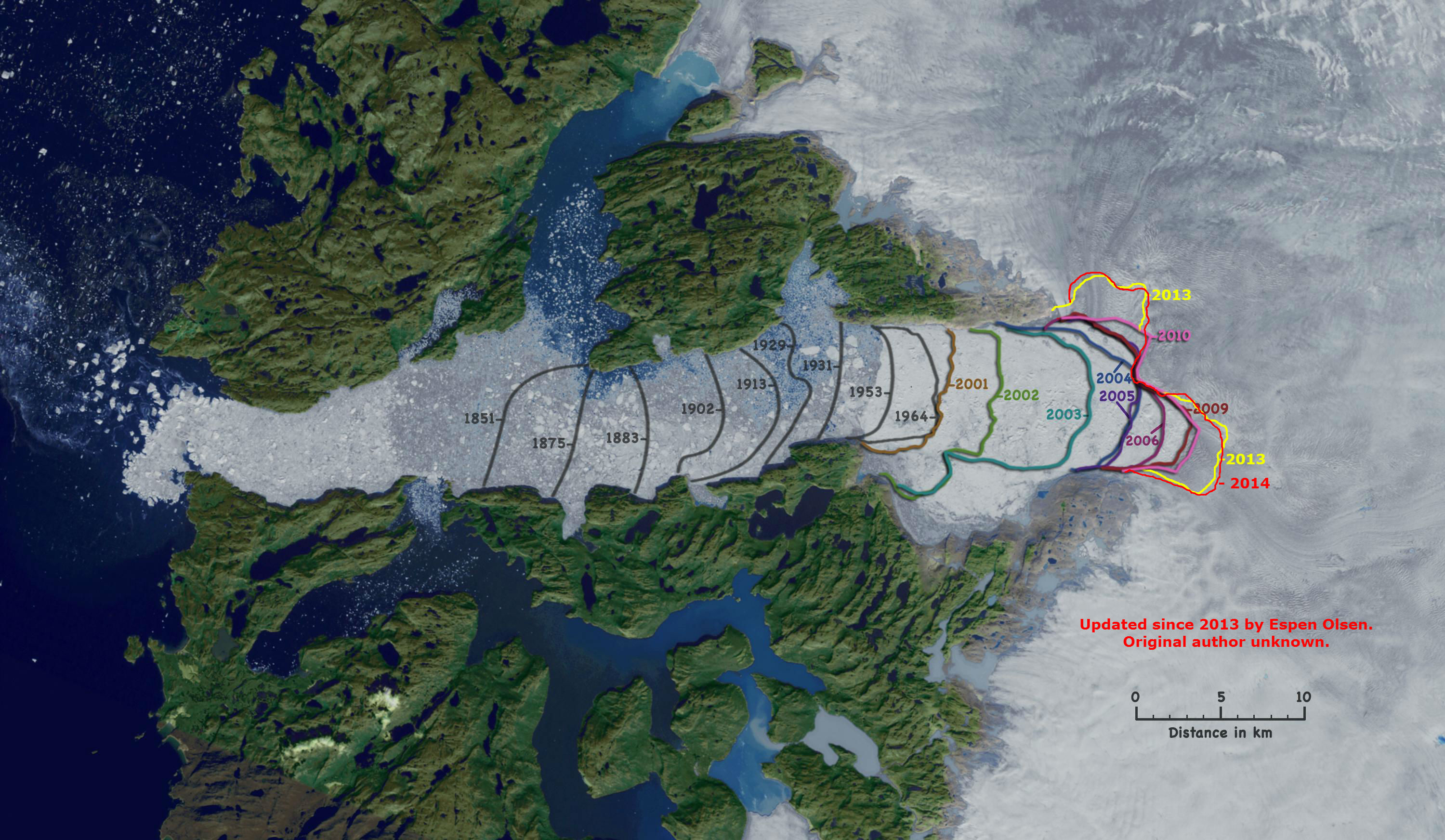
This most recent event does not bring the calving face further east than the position in summer 2014. However the sun’s rays are only just returning to that part of the planet, and the next one may well do so.
[Edit - 24/02/2015]
We’ve phoned DMI and NSIDC as well, but Jason Box who is a Professor at the Geological Survey of Denmark and Greenland has been the first to respond with an opinion about how unusual this event is:
It’s an interesting finding. In the attached prepared by Karina Hansen you will see a light yellow polygon illustrating the end of melt season 2014 ice. Jakobshavn front position retreated from the Feb 2014 (pink line) and Feb 2015 (green line) positions. The Feb 2014 and Feb 2015 positions are roughly the same with 2014 Feb being further retreated than Feb 2015:
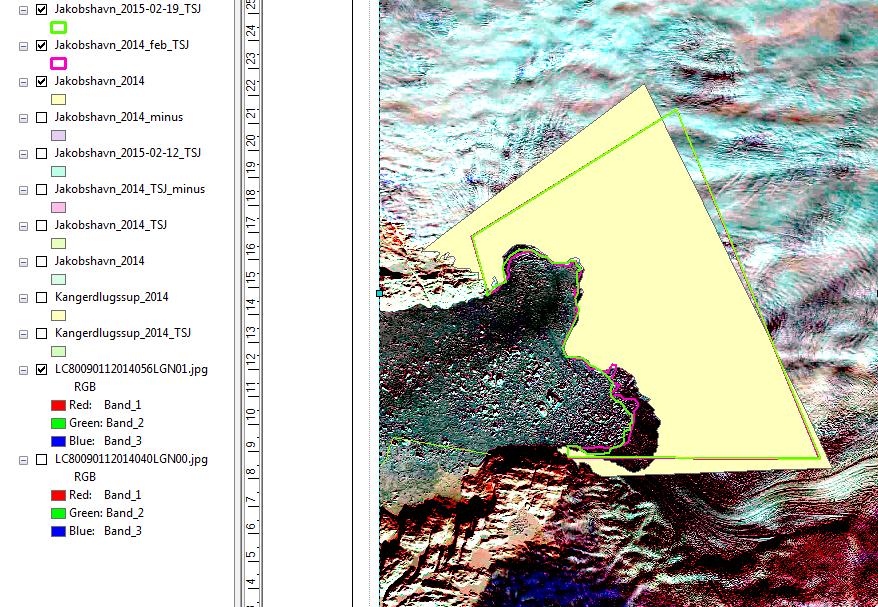
A cautious response: even if this calving were abnormal, we will likely see an advance in the next weeks that will fill the void. Why?
A) This glacier flows fast, and
B) Now with less flow resistance there will likely be an acceleration making the void filling happen even faster.
Here are annual end of melt season area changes measured by PROMICE.org. These are being updated. I will ask Karina Hansen today to update for 2014 and 2015. We could have that result in a few hours.
luni, 9 martie 2015
Loose ICE (University of Rhode Island) "Cracks in the Cryosphere: How Changes in Sea Ice Can Upset the Ocean Carbon Cycle (Universite Libre de ICE IV "The Cryosphere Between the Cracks AND THE CRACKPOTS: Does It Matter TO THE MARCHING MORONS GOING UP A DIME BIGGEST YEAR IN NASDAQ IN YEARS THE XXI CENTURY FOX IS JUST FINE AND GOING TO GO FINER OR THINNER SOMETHING LIKE THIS OR LIKE THAT TIT FOR TAT
Arctic sea ice extent continues to track well below average, but it is still unclear whether March will see an increase in ice, or establish a record low maximum. Regionally, Arctic ice extent is especially low in the Sea of Okhotsk and the Bering Sea. In the Antarctic, sea ice shrank to the fourth highest minimum in the satellite record.
Overview of conditions
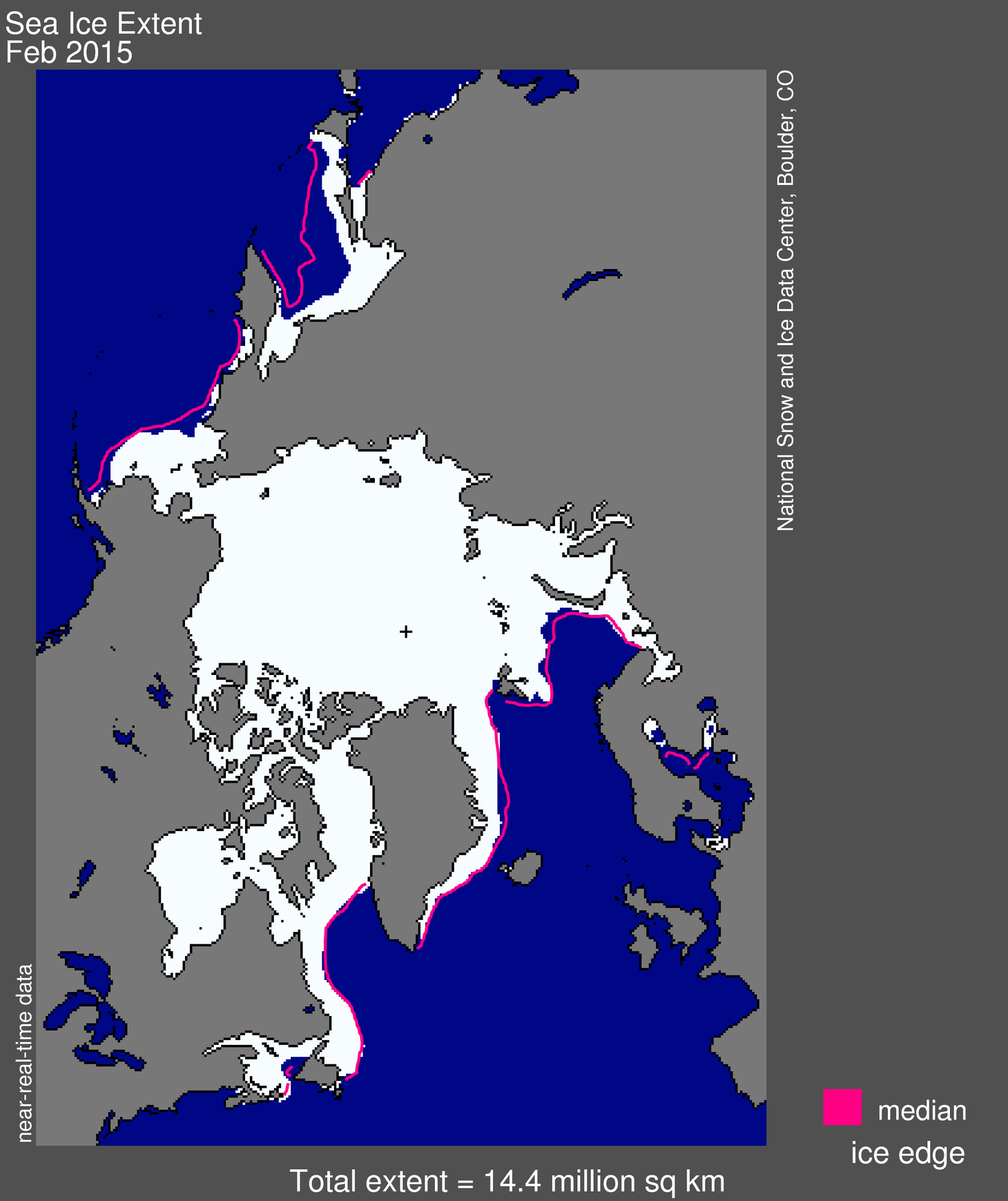
Figure 1. Arctic sea ice extent for February 2015 was 14.41 million square kilometers (5.56 million square miles). The magenta line shows the 1981 to 2010 median extent for that month. The black cross indicates the geographic North Pole. Sea Ice Index data.About the data
Credit: National Snow and Ice Data Center
High-resolution image
Credit: National Snow and Ice Data Center
High-resolution image
Arctic sea ice extent in February averaged 14.41 million square kilometers (5.56 million square miles). This is the third lowest February ice extent in the satellite record. It is 940,000 square kilometers (362,900 square miles) below the 1981 to 2010 long-term average of 15.35 million square kilometers (5.93 million square miles). It is also 50,000 square kilometers (19,300 square miles) above the record low for the month observed in 2005.
With the Arctic Ocean completely ice covered, the remaining areas of potential new ice growth are limited to the margins of the pack in the northern Pacific and northern Atlantic. Sea ice extent is below average across the entire sea ice margin, most prominently along the Pacific sectors. A small region of above-average ice extent is located near Newfoundland and the Canadian Maritime Provinces.
The Arctic maximum is expected to occur in the next two or three weeks. Previous years have seen a surge in Arctic ice extent during March (e.g., in 2012, 2014). However, if the current pattern of below-average extent continues, Arctic sea ice extent may set a new lowest winter
joi, 19 februarie 2015
DO TEMPO E DO ESPAÇO PASSO A PASSO ...NO ESPAÇO DE UM PASSO PASSO A BOLA À TOLA DE UM TOLO NO PAÇO COM CACHECOL OU MESMO COM OUTRO LAÇO ...ATÉ César METIA CunhaS E TINHA Dias O Sócrates é que já não vai a tempo......TUDO VAI A TEMPO SE A ALMA NÃO É PEQUENA ........O CONCEITO DE ESPAÇO-TEMPO PERMITE AFIRMAR QUE SOCRATES VAI SEMPRE A TEMPO ...HÁ UMA FUSÃO ÍNTIMA ENTRE ESPAÇO E TEMPO NO ESPAÇO TEMPO CORRESPONDENTE À GAY PARIS OU À CU RUPÇÃO DA JUVENTUS DE ATHENAS SOCRATES NAVEGA NO ESPAÇO RELATIVO E NO TEMPO RELATIVO ...É TUDO CÁ DUMA RELATIVIDADE .OR THE RELATIVE TIME AND RELATIVE SPACE IN THE CONTINUUM OF SOCRATIC CU RUPÇÃO DA JUVENTUS DE ATHENAS EMERGINDO DESTA REALIDADE FACEBOOKIANA UM NOVO ABSOLUTO ESPÁCIO-TEMPORAL A NOÇÃO DE INTERVALO ENTRE DOIS ACONTECIMENTOS ...O ACTO CORRUPTOR E O PERDÃO ATÉ 30 DIAS COMO PRAZO DE VALIDADE DOS PERDÕES DA CRISTANDADE....NA RÁDIO OUVE-SE DESCREVER ESTE INTERVALO TEMPORAL DE 30 DIAS COMO SE SE TRATASSE DE UMA QUARTA DIMENSÃO NILTONIANA MAS NADA PHODIA IPODEPODE SER MAIS FALSO COMO SE A RELATIVIDADE FIZESSE DESAPARECER TODA A DISTÂNCIA ENTRE O SPACE E O TIME DO SOCRÁTICO CU RUPTOR .. MAS NA REALIDADE OU NA RELATIVIDADE DO FACEBOOK O TEMPO TEM UM PAPEL OU MESMO UM RÁDIO...COMPLETAMENTE DISTINTO DO ESPAÇO RADIOFÓNICO OU MESMO DO ESPAÇO AFÓNICO DO FACEBOOK..... O ESPAÇO TEMPO NÃO TEM QUATRO DIMENSÕES TEM QUATRO VARIÁVEIS TODAS ELAS CORRUPTÍVEIS O RELATIVISTA FACEBOOKIANO SABE QUE PODE PERFEITAMENTE CORROMPER AS TRÊS DIMENSÕES E AFINFAR NA 4ªFALSA DIMENSÃO ESSA VARIÁVEL QUE É O TEMPO ....NESTE CASO VARIA SÓ 30 DIAS ...SÃO MANIAS .-O RELATIVISTA CHAMA A ESSE DISPARATE QUE OS LEIGOS PERCEPCIONAM COMO 30 DIAS CURVATURA DO CONTÍNUO NO ESPAÇO TEMPO SE BEM QUE CONTÍNUO FIQUE MELHOR EM LATIM ....TEMOS ASSIS OU ASSAD NO INTERVALO DE 30 DIAS ENTRE ACONTECIMENTOS DE DAR E LEVAR NO VIEGAS NÃO SEJAIS PIEGAS UMA FUNÇÃO MATEMÁTICA E LEGAL ANÁLOGA À DA CURVATURA A 3 DIMENSÕES DO ROTUNDO BUJÃO ALEMÃO QUE PERDEU QUASE TODAS AS GUERRAS OU SEJA A CURVATURA DE UMA SUPERFÍCIE IRREAL COMO O FACEBOOK...ORA CURVATURA DOS 30 DIAS É UM CONCEITO OU UMA CON SEITA OU UMA NOÇÃO CONCRETA E PODE SER APLICADA NO NILTON NOS BOYS DE SOCRATES E MESMO NO CONTÍNUO TEMPORAL OU NOUTRO CONTÍNUO ....UM DOMÍNIO ASSAZ OU ASSAD SINGULAR POIS NENHUMA TEORIA MESMO NILTONIANA PODE APAGAR CERTAS CARACTERÍSTICAS DO TEMPO ESPECÍFICAS DO DITO CUJO ..POR UM LADO O INTERVALO DE 30 DIAS ENTRE ACONTECIMENTOS DE DIFERENTES GRAUS DE PROBABILIDADE CORROMPER OU CU ROMPER E SER PERDOADO POR OUTRO LADO A PERSISTÊNCIA DOS OBJECTOS CORROMPIDOS QUE INTRODUZEM NESTE SISTEMA ANAL PENAL PENIS-ANAL UMA DISSEMETRIA OU DISSEMELHANÇA IMPRESSIONANTE EM TERMOS NILTONIANUS.
JÁ AS VARIÁVEIS DO ESPAÇO PODEM
VARIAR INDIFERENTEMENTE
ENQUANTO O TEMPO ESCORRE OU CORRE
OU VAI A PASSO NUM SENTIDO QUE NOS
É PERCEPCIONADO COMO ÚNICO
ESTA IRREVERSIBILIDADE DO TEMPO
E O CARÁCTER IRREVOGÁVEL DAS
DECISÕES DE PORTAS VON PAULUS
NA EVOLUÇÃO DOS SISTEMAS FÍSICOS
ENCONTRAM A SUA EXPRESSÃO NO 2º
PRINCÍPIO DA TERMODINÂMICA ...
VARIAR INDIFERENTEMENTE
ENQUANTO O TEMPO ESCORRE OU CORRE
OU VAI A PASSO NUM SENTIDO QUE NOS
É PERCEPCIONADO COMO ÚNICO
ESTA IRREVERSIBILIDADE DO TEMPO
E O CARÁCTER IRREVOGÁVEL DAS
DECISÕES DE PORTAS VON PAULUS
NA EVOLUÇÃO DOS SISTEMAS FÍSICOS
ENCONTRAM A SUA EXPRESSÃO NO 2º
PRINCÍPIO DA TERMODINÂMICA ...
Abonați-vă la:
Postări (Atom)